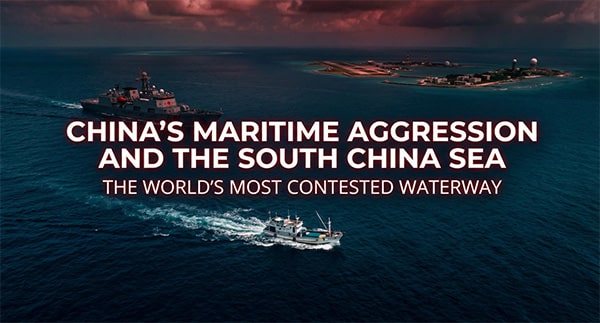

The South China Sea is simultaneously the world’s most commercially vital maritime corridor and its most dangerous geopolitical flashpoint. Stretching across 3.5 million square kilometers between China, Taiwan, Vietnam, the Philippines, Malaysia, Brunei, and Indonesia, it carries an estimated one-third of all global shipping and accounts for approximately 21 percent of world trade by value — figures equivalent to more than $3.4 trillion annually (CSIS China Power Project, 2021). The Strait of Malacca, through which the bulk of South China Sea traffic is channeled, is the world’s second busiest sea lane after the English Channel and has no practical alternative for vessels linking the Indian Ocean to the Pacific. Against this backdrop, the People’s Republic of China has pursued a sustained, methodical campaign to convert its unilateral territorial claims across this waterway into physical and legal facts on the ground — using its coast guard, navy, and maritime militia as instruments of coercion against smaller claimant states, above all the Philippines. In 2025 and into 2026, that campaign has intensified to the point where senior U.S. officials, defense analysts, and Philippine military commanders are openly discussing the risk of miscalculation triggering a conflict that would implicate America’s treaty obligations and convulse the global economy. This essay examines the current state of China’s maritime aggression in the South China Sea, its implications for freedom of navigation and commercial shipping, the U.S. and allied response, and the structural risks that make this one of the most pressing maritime security challenges of 2026.
China’s Claims and the Legal Vacuum
China claims approximately 90 percent of the South China Sea under its so-called nine-dash line, a boundary with no basis in international law that was definitively rejected by the Permanent Court of Arbitration at The Hague in a July 2016 ruling brought by the Philippines under the United Nations Convention on the Law of the Sea (UNCLOS). The tribunal found in Manila’s favor on virtually every count, ruling that China’s historical claims had no legal validity and that its island-building activities in the Spratly Islands had violated the Philippines’ exclusive economic zone (EEZ) rights (Congressional Research Service [CRS], 2024). China has refused to recognize the ruling or the tribunal’s authority, and has proceeded with its campaign of island construction and military basing in the Spratlys and Paracels as if the judgment had never been issued.
The consequence is a legal vacuum in one of the world’s most commercially critical maritime corridors. The CSIS China Power Project has documented that China’s island and reef facilities — constructed on what were previously uninhabited features or submerged reefs — now host airstrips, radar installations, missile batteries, and coast guard facilities that project Chinese power across the entire South China Sea (CSIS China Power Project, 2021). These installations have transformed the operational environment for commercial shipping, military vessels, and fishermen from every claimant state. China’s argument that these facilities serve civilian purposes — navigation safety, weather monitoring, search and rescue — is contradicted by their military configuration and the pattern of coercive operations conducted from them (Indo-Pacific Defense Forum, 2025a).
The Escalating Campaign Against the Philippines
No bilateral relationship better illustrates the danger of China’s maritime aggression than its sustained confrontation with the Philippines. Fox News has reported extensively on a pattern of Chinese Coast Guard (CCG) and People’s Liberation Army Navy (PLAN) operations that have included water cannon attacks on Philippine government vessels, deliberate ramming of coast guard ships, seizure of food supplies intended for Filipino forces stationed at the grounded BRP Sierra Madre on Second Thomas Shoal, blocking of medical evacuations, and military-grade laser targeting of Philippine vessels (Fox News, 2024a; Fox News, 2024b). China’s Coast Guard nearly tripled its patrols around Sabina Shoal in 2025, and in August 2025 a CCG vessel and a PLAN ship actually collided with each other during an operation to harass a Philippine Coast Guard vessel near Scarborough Shoal — an incident that Philippine military officials described as illustrating “the dangers and risk posed by China’s recklessness” (Indo-Pacific Defense Forum, 2025b, para. 4).
The Philippines has responded with a transparency strategy — systematically releasing video and photographic evidence of Chinese aggression to international media — that has garnered significant international support while doing nothing to deter the underlying behavior. Philippine Coast Guard spokesman Commodore Jay Tarriela acknowledged the paradox plainly: “They are still depending on their water cannon… they are still stuck with that kind of tactic,” while noting that the frequency of incidents had not decreased (as cited in Fox News, 2024c, para. 6). As recently as March 24, 2026, PCG Commandant Admiral Ronnie Gil Gavan declared that Philippine sovereignty “is non-negotiable” as Manila deployed vessels to counter fresh Chinese aggression at Scarborough Shoal — demonstrating that the confrontation is continuous, not episodic (Manila Bulletin, 2026).
China expert Gordon Chang, a fellow at the Gatestone Institute, told Fox News Digital that China was “not respecting” the U.S.-Philippines Mutual Defense Treaty, noting that the State Department had issued formal written warnings to Beijing on multiple occasions that Washington was “prepared to use force” to discharge its Article 4 obligations — statements that Chang characterised bluntly as “a warning that we are prepared to go to war” (Fox News, 2024d, para. 3–4). President Marcos Jr. of the Philippines has himself warned that should a Philippine citizen lose their life in a confrontation with Chinese forces, “we would have crossed the Rubicon” (Fox News, 2024e, para. 3).
The Code of Conduct Problem
An ASEAN-China Code of Conduct (COC) for the South China Sea has been under negotiation since 2002, with formal talks beginning only in 2017. As the Philippines assumed the ASEAN chairmanship in 2026 and vowed to press for a legally binding agreement, analysis from the East Asia Forum and the ISEAS-Yusof Ishak Institute in Singapore confirmed what most regional experts had long suspected: Beijing’s preference is for a non-binding, flexible arrangement that avoids external scrutiny and ASEAN-led monitoring — the diametric opposite of what the Philippines and other claimant states require (East Asia Forum, 2026). China has resisted any COC framework that would meaningfully constrain its freedom of action or subject it to international adjudication it cannot control. Without a binding COC, the South China Sea remains governed by competing unilateral claims, selective application of international law, and the balance of physical power between China and its neighbors — a balance that has steadily shifted in Beijing’s favor.
The SAIS Review noted in February 2026 that despite a U.S. Pacific Fleet commander’s assessment that China’s strategy of intimidation was “failing” to coerce Southeast Asian states, the failure itself carries its own risk: that Beijing, confronted with the closure of a strategic window as regional deterrence capabilities strengthen, could move toward more drastic action (SAIS Review, 2026). Johns Hopkins professor Gregory Poling has argued that President Xi Jinping has consolidated power to the point where escalation could become the norm, as CCP party members are unwilling to challenge his strategic judgments even when they carry catastrophic risk (as cited in SAIS Review, 2026).
The U.S. Response and Alliance Architecture
The United States has significantly strengthened its military posture in the South China Sea in response to China’s intensifying aggression. Fox News reported in February 2026 that the U.S. was expanding deployments of advanced missile systems in the northern Philippines, building on the April 2024 deployment of the Army’s Typhon ground-based launcher — capable of firing Tomahawk cruise missiles with a 1,000-mile range — to Luzon (Fox News, 2026). The Navy-Marine Expeditionary Ship Interdiction System was deployed in 2025 to Batan Island, facing the strategically critical Bashi Channel connecting the South China Sea to the Western Pacific. In a joint statement, the U.S. and Philippines condemned China’s “illegal, coercive, aggressive and deceptive activities in the South China Sea, recognizing their adverse effects on regional peace and stability and the economies of the Indo-Pacific” (Fox News, 2026, para. 4). The U.S. committed to holding over 500 military exercises with the Philippines in 2026 — a record level that reflects the deepening of the alliance in direct response to Chinese pressure (SAIS Review, 2026).
Japan has also moved meaningfully, solidifying a mutual defence agreement with the Philippines that took effect in September 2025, conducting joint South China Sea patrols alongside the U.S. Seventh Fleet, and committing to major expansions of its own maritime defense capabilities. Australia, Canada, France, and the United Kingdom have all participated in multilateral exercises in the Philippine Sea. This coalition-building is significant — but it does not resolve the underlying structural tension that China’s island-building, which was not deterred when it occurred, has already changed the physical geography of the sea lane in Beijing’s favor (East Asia Forum, 2026).
Commercial Shipping and the Economic Stakes
The commercial stakes of the South China Sea dispute are difficult to overstate. The Atlas Institute for International Affairs documented that freight rates on key Asian routes more than doubled between January and July 2024, with insurance premiums for South China Sea transits rising in tandem, as markets began pricing regional instability into voyage costs (Atlas Institute, 2025). For China itself, over 64 percent of its maritime trade transited the South China Sea in 2016 — a figure that has only grown as China’s economy expanded — meaning Beijing has a profound structural interest in keeping the waterway commercially navigable, even as its military and coast guard activities threaten to make it less so (CSIS China Power Project, 2021). This internal contradiction sits at the heart of the Chinese South China Sea strategy: asserting sovereignty maximally while insisting commercially that nothing has changed.
For the United States and its allies, the CRS has noted that China’s excessive maritime claims — if left unchallenged — could restrict freedom of navigation and military access across more than one-third of the world’s oceans, given the geographic reach of China’s EEZ claims and their compounding effect on global maritime law (CRS, 2024). The Malacca Strait closure scenario alone — the most extreme version of South China Sea disruption — would replicate something comparable to the 2011 Thailand floods’ effect on global manufacturing supply chains, potentially dropping worldwide production of key goods by 30 percent while prices skyrocketed (CSIS China Power Project, 2021)
Conclusion
The South China Sea in 2026 is a body of water where the line between maritime security and military confrontation is narrowing by the week. China has established a comprehensive coercive infrastructure across the Spratly and Paracel Islands; it is deploying its coast guard and maritime militia on an almost daily basis to assert control against the Philippines and other claimant states; it has rejected the only authoritative international legal ruling on its claims; and it is resisting any binding code of conduct that would constrain its actions. The United States has responded with a significant military build-up, treaty reaffirmations, and expanded alliance architecture — but the underlying physical and legal facts in Beijing’s favour have already been established. The risk is not just of a regional war with catastrophic consequences for global trade. It is of a creeping normalisation of coercion in one of the world’s most critical maritime commons — a normalisation that, if allowed to solidify, will redefine the rules of the sea for every nation that depends on them.
References
Atlas Institute for International Affairs. (2025, July 4). The $5.3 trillion question: How South China Sea tensions are rewriting global trade rules.https://atlasinstitute.org/the-5-3-trillion-question-how-south-china-sea-tensions-are-rewriting-global-trade-rules/
CSIS China Power Project. (2021). How much trade transits the South China Sea?https://chinapower.csis.org/much-trade-transits-south-china-sea/
Congressional Research Service. (2024). U.S.-China strategic competition in South and East China Seas: Background and issues for Congress (R42784). https://www.congress.gov/crs-product/R42784
East Asia Forum. (2026, February 27). Drifting through dispute in the South China Sea.https://eastasiaforum.org/2026/02/27/drifting-through-dispute-in-the-south-china-sea/
Fox News. (2024a, August 19). China and the Philippines trade blame after ships collide in disputed South China Sea.https://www.foxnews.com/world/china-philippines-trade-blame-ships-collide-disputed-south-china-sea
Fox News. (2024b, June 18). China attacks on Philippine boats are to provoke US, prep for Taiwan war, experts warn.https://www.foxnews.com/world/china-attacks-philippine-boats-provoke-us-prep-taiwan-war-experts-warn
Fox News. (2024c, June 20). The Philippines’ publicity approach to South China Sea clashes tests Beijing.https://www.foxnews.com/world/philippines-publicity-approach-south-china-sea-clashes-tests-beijing
Fox News. (2024d, April 7). WWIII could start over Philippines dispute in South China Sea, China ‘not respecting’ treaties, expert says.https://www.foxnews.com/world/wwiii-could-start-philippines-dispute-south-china-sea-china-not-respecting-treaties-expert-says
Fox News. (2024e, March 28). Beijing tells U.S. to butt out of China-Philippines dispute in South China Sea.https://www.foxnews.com/world/china-warned-as-philippine-president-proposes-countermeasures-against-beijings-aggression
Fox News. (2025). China’s global aggression check: Taiwan tensions, military posturing and US response in 2025.https://www.foxnews.com/politics/chinas-global-aggression-check-taiwan-tensions-military-posturing-us-response-2025
Fox News. (2026, February 18). US moves to expand missiles in Philippines, putting China within range.https://www.foxnews.com/politics/us-moves-expand-missiles-philippines-putting-china-within-range
Indo-Pacific Defense Forum. (2025a, December 1). Philippines to focus on South China Sea code of conduct despite China’s obstinance.https://ipdefenseforum.com/2025/12/philippines-to-focus-on-south-china-sea-code-of-conduct-despite-chinas-obstinance/
Indo-Pacific Defense Forum. (2025b, November 22). Philippines counters China’s aggression with 4 key initiatives.https://ipdefenseforum.com/2025/11/philippines-counters-chinas-aggression-with-4-key-initiatives/
Manila Bulletin. (2026, March 24). PCG vows firm stance in WPS, sends vessels amid new Chinese ‘threats.’https://mb.com.ph/2026/03/24/pcg-vows-firm-stance-in-wps-sends-vessels-amid-new-chinese-threats
SAIS Review of International Affairs. (2026, February 13). A calm before the storm: South China Sea powder keg.https://saisreview.sais.jhu.edu/a-calm-before-the-storm-south-china-sea-powder-keg