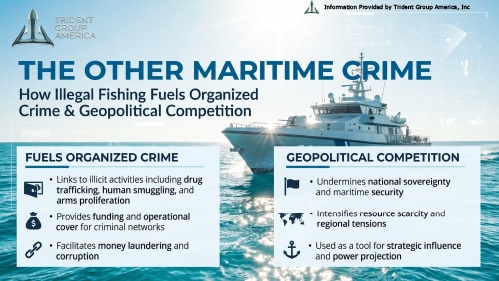

In November 2024, the U.S. Department of the Treasury’s Office of Foreign Assets Control sanctioned five Mexican nationals connected to the Gulf Cartel for crimes that would have seemed unrelated ten years ago: illegal, unreported, and unregulated fishing in the Gulf of Mexico, narcotics trafficking, and human smuggling. All of these activities took place on the same vessels, along the same routes, and generated income for the same criminal organization (U.S. Department of the Treasury, 2024). The Gulf Cartel’s ‘lancha’ operations—fast, light fishing boats based on Mexico’s northeastern coast—crossed into U.S. waters to catch red snapper and shark species under strict American conservation limits, brought the catch back to Mexico for sale, and used the same boats and routes to move drugs and migrants across the Rio Grande (ICE, 2024). Treasury described IUU fishing as ‘a revenue stream for criminal organizations’ that use ‘the same vessels for smuggling narcotics and humans across borders,’ and this was not just a policy statement (U.S. Department of the Treasury, 2024, para. 3). It was a direct description of how transnational crime operates at sea in 2024 and 2025. This essay argues that illegal, unreported, and unregulated fishing, once seen mainly as an environmental or economic issue, has become a major but often overlooked maritime security threat. It now serves as a source of funding for transnational organized crime, a platform for human trafficking and forced labor, and a tool used by the Chinese Communist Party to assert sovereignty, pressure rivals, and expand its influence across the world’s oceans.
To understand IUU fishing as a security problem, it is important to look at its economic scale. The money it generates is what attracts transnational criminal networks. In the Gulf of Guinea, which stretches from Senegal to Angola and is one of the world’s richest fishing areas, IUU fishing costs the region about $2.3 billion each year in lost revenue. This loss directly weakens the budgets of countries that already have limited resources (Casade, 2026; Africa Defense Forum, 2023). Some estimates, which include unreported activity, put the total cost to West African governments and economies between $2.3 billion and $9.4 billion a year. This wide range shows how much illegal fishing goes unreported (Africa Defense Forum, 2023).
Worldwide, researchers believe that about 15 percent of all fish caught in the ocean is illegal. This is not just lost government income. It also means fish stocks are being depleted, which affects the 3.3 billion people who rely on fish as a main source of protein (The Regulatory Review, 2024).
About 5.2 million people in West Africa who work in small-scale local fisheries are directly threatened by foreign industrial vessels that fish without permission (MariTimes Crimes, 2024). As these communities see their catches shrink, a trend local fishermen have described as watching fish stocks vanish from waters their families have relied on for generations, economic hardship grows. This hardship makes it easier for piracy networks, drug traffickers, and irregular migration groups to recruit new members. The Congressional Research Service’s December 2025 report to the 119th Congress pointed out that the same conditions that allow IUU fishing, such as poor governance and vulnerability to illegal activities, also create an environment where other types of transnational crime can thrive (CRS, 2025). Fish are the resource that attracts criminal networks to these waters, and the vessels and routes they use support other criminal activities as well.
The overlap between IUU fishing, drug trafficking, arms smuggling, and human trafficking is not accidental. It follows a clear criminal business logic. Maritime security expert Nasir Saheed explained it this way: “As a criminal, they would reason why don’t they just add some other ‘venture’ to it like drugs, and because they are already involved in other criminal enterprises, they would not find it hard or wrong to keep people against their will, and moving people from one part of the world to another” (Africa Defense Forum, 2023, para. 3). A vessel that already operates outside the law, has the networks to avoid authorities, and moves in remote waters where enforcement is weak, can easily carry extra illegal cargo with little extra cost or risk. The Regulatory Review’s 2024 analysis noted that “on international waters, safe from the reach of domestic law enforcement, commercial vessels engaged in unlawful fishing have slowly become entangled in drug smuggling, organized crime, and even human trafficking” because they operate where there is little enforcement (The Regulatory Review, 2024, para. 2).
Human trafficking is a serious and often underreported part of the IUU fishing problem. These vessels often recruit crew members through false promises—employment agencies advertise offshore fishing jobs that are nothing like the reality. Once on board, workers are kept in line through debt bondage, having their passports taken, threats of violence, and the fact that escape is nearly impossible when far out at sea (Congress.gov, 2025). In 2022, the Treasury Department designated two executives of Pingtan Marine Enterprise, a Chinese fishing company listed on NASDAQ, and 157 related vessels under the Global Magnitsky Human Rights Accountability Act for serious human rights abuses. This was the first time the Treasury had targeted a NASDAQ-listed company, and the investigation found physical violence, forced labor, extreme isolation, and denial of medical care on these vessels (U.S. Department of the Treasury, 2022). The International Labor Organization has found “strong links between IUU fishing and the use of forced labor on board,” noting that isolation, long voyages, and vulnerable migrant workers create the perfect conditions for large-scale labor exploitation (U.S. Department of the Treasury, 2022, para. 6). In September 2022, dozens of human trafficking victims were rescued from two industrial fishing vessels in Namibian waters. This single enforcement action shows what systematic monitoring of IUU fleets might uncover across the world’s oceans (Africa Defense Forum, 2023).
The connection between IUU fishing and drug trafficking is also well documented. The Gulf of Guinea has become the main route for South American cocaine heading to Europe, using the same vessels, ports, and networks involved in IUU fishing in West African waters (Casade, 2026; MariTimes Crimes, 2024). An October 2025 report by Modern Diplomacy showed that pirate revenues help fund extremist groups like Boko Haram and ISWAP, while money from IUU fishing moves through the same financial channels that support regional insurgencies (Modern Diplomacy, 2025). Global Financial Integrity summed up the situation: “The same symptoms that benefit illegal fishing, poor governance, weak rule of law, insufficient capacity, and lack of political will also benefit all other forms of transnational organized crime” (Global Financial Integrity, 2019, para. 4). IUU fishing does not just exist alongside organized crime; it relies on the same conditions and infrastructure.
The IUU fishing security problem assumes its most significant strategic dimension when viewed through the lens of China’s deliberate weaponization of its distant-water fleet. The security risks of IUU fishing are most serious when considering how China has turned its distant-water fishing fleet into a strategic tool. China has the world’s largest distant-water fishing fleet, and when militia-linked and foreign-flagged vessels are included, it dominates commercial fishing in nearly every ocean (Indo-Pacific Defense Forum, 2026a). A January 2026 report by two U.S. congressional committees, “China’s Global Fishing Offensive,” made it clear that this fleet is not just a business. According to the report, it is “part of a coordinated strategy to expand CCP power overseas, weaken competitors and increase other nations’ dependence on China’s seafood processing” (Indo-Pacific Defense Forum, 2026a, para. 3). The report also found that Beijing “wields the fleet with the precision of a military command, fusing fishing vessels, state subsidies, processing plants and overseas infrastructure into a unified geopolitical weapon,” moving vessels in coordination with diplomatic and military goals (Indo-Pacific Defense Forum, 2026a, para. 3).
The South China Sea dimension is the most operationally concrete expression of this strategy. China’s People’s Armed Forces Maritime Militia — officially acknowledged by the U.S. Department of Defense as the PAFMM — resides under the direct command and control of the People’s Liberation Army and augments Chinese Coast Guard and Navy operations throughout the South China Sea using nominally civilian fishing vessels as cover (RAND, 2020). According to a February 2026 report from CSIS’s Asia Maritime Transparency Initiative, China’s maritime militia maintained a record daily average presence of 241 boats in the South China Sea in 2025, increasing its activity at Mischief and Whitsun Reefs while simultaneously expanding its overall footprint across the region (Indo-Pacific Defense Forum, 2026b). On Christmas Day 2025, more than 2,000 Chinese fishing vessels deployed to the East China Sea and assembled a mock blockade in a reverse-L formation. Two weeks later, on January 14, 2026, 1,400 fishing vessels performed a similar maneuver in the same waters (Asia Times, 2026).
The U.S. Naval Institute has estimated that China has 200,000 fishing vessels that could be weaponized —a force of nominally civilian vessels that provides Beijing with a scale of gray-zone maritime presence that no conventional naval force could replicate or counter without risking escalation (Asia Times, 2026).
RAND Corporation’s analysis shows that the PAFMM has changed from doing coastal patrols in the 1970s to becoming a tool for asserting sovereignty. It can “win without fighting” by sending large groups of fishing vessels to overwhelm other countries and “change the facts on the ground — or at sea” to challenge their control over disputed areas (RAND, 2020, para. 4). The Stimson Center’s 2025 report explained that this approach creates a cycle: Chinese state fishing subsidies make their vessels competitive in disputed waters, even if their catch is illegal, and the militia role lets Beijing assert territorial claims through constant presence. No other country can match this without directly confronting the Chinese military (Stimson Center, 2025). The U.S. Department of State reported that in 2016, hundreds of Chinese fishing vessels swarmed the Senkaku Islands “in a move calculated by the CCP to undermine Japan’s administration,” setting a precedent for the mock blockades in December 2025 and January 2026 (U.S. Department of State, 2021).
The U.S. government has recognized the IUU-crime nexus at the legislative and executive levels with increasing sophistication since the passage of the Maritime Security and Fisheries Enforcement (SAFE) Act, which for the first time formally linked IUU fishing to transnational organized crime, drug and arms trafficking, and forced labor within a single statutory framework requiring a whole-of-government response (U.S. Department of State, 2024). The SAFE Act established a 21-member Interagency Working Group on IUU Fishing, drawing on NOAA, the State Department, the U.S. Coast Guard, Treasury’s OFAC, and multiple law enforcement agencies, and directed the creation of a national strategy that explicitly frames IUU fishing as a maritime security problem rather than a fisheries management problem (Congress.gov, 2025). The 119th Congress introduced the FISH Act of 2025, which would extend sanctions authority to IUU-linked vessels through existing transnational crime and Global Magnitsky frameworks, creating a blacklist mechanism for vessels with documented IUU ties and enabling coordinated designation with allied governments (Congress.gov, 2025a). The Department of Defense designated IUU fishing as a secondary security concern warranting Department of War engagement under Executive Order 14347, signed September 5, 2025 — the first time the Defense establishment had been formally incorporated into the IUU counterstrategy (CRS, 2025).
The US Coast Guard’s shiprider program, which allows officers from partner nations to join Coast Guard cutters and extend enforcement into exclusive economic zones where the U.S. does not have sole authority, is now the main way IUU fishing is stopped in the Indo-Pacific. In 2024, shiprider agreements were active with 14 partner countries (U.S. Department of State, 2024). The USS Harriet Lane was highlighted in a congressional report on China’s global fishing offensive as a good example of joint maritime governance, providing a steady presence and a platform for shiprider operations with 12 Indo-Pacific partners at the same time (Indo-Pacific Defense Forum, 2026a).
IUU fishing is not just about fish quotas. It is a maritime security issue. Large parts of the ocean—45 percent of the planet’s surface that are outside any country’s control, plus the big exclusive economic zones of countries that cannot patrol their own waters—have been taken over by transnational criminal networks. These groups use fishing as a cover for drug trafficking, human trafficking, forced labor, and arms smuggling. At the same time, some governments have turned fishing fleets into tools for asserting sovereignty and strategic pressure. The $2.3 billion lost each year in the Gulf of Guinea is not just about missing fishery income; it is about the destruction of the economic base of coastal communities. This poverty and instability lead to piracy, recruitment into criminal groups, and irregular migration, all of which cause the region’s maritime security problems. The daily average of 241 Chinese militia vessels in the South China Sea, which grew to 2,000 vessels in a mock blockade on Christmas Day 2025, is not just a fishing number. It shows how far fishing has been turned into a tool for great power competition. These problems will continue and get worse as long as the world treats them as side issues of fisheries management instead of the main maritime security threats they really are.
Africa Defense Forum. (2023, April 11). Human trafficking linked to illegal fishing in Gulf of Guinea.https://adf-magazine.com/2023/04/human-trafficking-linked-to-illegal-fishing-in-gulf-of-guinea/
Asia Times. (2026, February). China’s fishing fleets are Beijing’s secret naval weapon.https://asiatimes.com/2026/02/chinas-fishing-fleets-are-beijings-secret-naval-weapon/
Casade. (2026, March). Maritime security in the Gulf of Guinea: A comprehensive guide to regional stability in 2026.https://casade.org/uncategorized/maritime-security-in-the-gulf-of-guinea-a-comprehensive-guide-to-regional-stability-in-2026/
Congress.gov. (2025, December 23). Illegal, unreported, and unregulated (IUU) fishing: Frequently asked questions (CRS R48215). https://www.congress.gov/crs-product/R48215
Congress.gov. (2025a). Text — H.R.3756 — 119th Congress (2025–2026): FISH Act of 2025.https://www.congress.gov/bill/119th-congress/house-bill/3756/text
Global Financial Integrity. (2019). The serious impacts of fisheries crime.https://gfintegrity.org/the-serious-impacts-of-fisheries-crime/
ICE. (2024, November 27). Treasury targets cartel-enabled illegal fishing operations following HSI RGV investigation.https://www.ice.gov/news/releases/treasury-targets-cartel-enabled-illegal-fishing-operations-following-hsi-rgv
Indo-Pacific Defense Forum. (2026a, February 2). China wields fishing force as geopolitical weapon, report finds.https://ipdefenseforum.com/2026/02/china-wields-fishing-force-as-geopolitical-weapon-report-finds/
Indo-Pacific Defense Forum. (2026b, March). Beijing’s South China Sea militia fleet largest ever, report says.https://ipdefenseforum.com/2026/03/beijings-south-china-sea-militia-fleet-largest-ever-report-says/
MariTimes Crimes. (2024, July 16). Crime and conflicts of interest: The Gulf of Guinea under high tension.https://maritimescrimes.com/2024/07/16/gulf-of-guinea-crime-and-conflic/
Modern Diplomacy. (2025, October 13). Piracy in the Gulf of Guinea: Maritime crime and insecurity.https://moderndiplomacy.eu/2025/10/13/piracy-in-the-gulf-of-guinea-maritime-crime-and-insecurity/
RAND Corporation. (2020, April). A short history of China’s fishing militia and what it may tell us.https://www.rand.org/pubs/commentary/2020/04/a-short-history-of-chinas-fishing-militia-and-what.html
Stimson Center. (2025, November 18). Militarized commons: How territorial competition is weaponizing fisheries and destroying the South China Sea.https://www.stimson.org/2025/territorial-competition-weaponizing-fisheries-south-china-sea/
The Regulatory Review. (2024, May 25). Floating crime laboratories.https://www.theregreview.org/2024/05/25/floating-crime-laboratories/
U.S. Department of State. (2021). China’s military aggression in the Indo-Pacific region.https://2017-2021.state.gov/chinas-military-aggression-in-the-indo-pacific-region/
U.S. Department of State. (2024). U.S. efforts to combat illegal fishing and associated labor abuses.https://2021-2025.state.gov/u-s-efforts-to-combat-illegal-fishing-and-associated-labor-abuses/
U.S. Department of the Treasury. (2022, December 9). Treasury targets serious human rights abuse aboard distant water fishing vessels based in the People’s Republic of China. https://home.treasury.gov/news/press-releases/jy1154
U.S. Department of the Treasury. (2024, November 26). Treasury targets cartel-enabled illegal, unreported, and unregulated fishing operations. https://home.treasury.gov/news/press-releases/jy2729