
On July 6, 2025, the Liberian-flagged bulk carrier Magic Seas was attacked and sunk in the southern Red Sea by Houthi forces deploying what the Washington Institute’s maritime incident tracker subsequently documented as a coordinated strike combining anti-ship ballistic missiles, unmanned surface vessels, and armed fast attack craft (Washington Institute, 2025a). Two days later, a second Greek-operated bulk carrier, the Eternity C, was attacked in a raid of unprecedented complexity: eight swarming small craft including multiple explosive unmanned surface vessels struck the hull, armed men aboard separate boats laid suppressive fire at the bridge and security detail, and at least two missiles impacted the vessel, including the electro-optically guided Asef anti-ship ballistic missile and radar-guided Mandab-2 anti-ship cruise missiles (Washington Institute, 2025a). Four seafarers were killed. Eleven more remained in Houthi captivity for months afterward. The Magic Seas and Eternity C were not the victims of piracy. They were the victims of proxy maritime warfare, executed with military-grade precision by a non-state actor operating under the strategic direction of a regional power. The distinction is not semantic. It is the most important doctrinal shift in maritime security since the Somali piracy crisis — and unlike that crisis, it has not yet produced a security framework adequate to its threat.
The Houthi maritime campaign that began on October 19, 2023, when the group launched its first missiles toward Israel following the outbreak of the Gaza war, has no accurate precedent in the history of commercial shipping security (Washington Institute, 2024). It was not piracy, because the Houthis’ stated objective was not financial enrichment from individual vessels but the strategic coercion of governments through the systematic disruption of global commerce. It was not state warfare, because Yemen’s Houthi movement is a terrorist non-state armed group operating from territory it controls by force rather than legal authority. It was proxy maritime warfare — a category that the maritime security industry, its regulatory frameworks, its insurance architecture, and its operational doctrine were almost entirely unprepared for when the first missiles flew. The Washington Institute’s systematic documentation of the campaign identifies five successive phases of escalating targeting criteria through which the Houthis progressively expanded their definition of a legitimate commercial target: from Israel-linked vessels in November 2023, to all ships heading to Israeli ports in December 2023, to vessels linked to the United States and United Kingdom in January 2024, to ships whose operators had vessels visiting Israeli ports in May 2024, to an even broader targeting category announced in July 2024 (Washington Institute, 2024). Each phase forced additional vessels out of the southern Red Sea, methodically constructing what the Washington Institute characterized as an “anti-access/area-denial zone” over the Bab el-Mandeb chokepoint that no commercial security measure could penetrate (Washington Institute, 2024, para. 2).
By the time the Houthis suspended their maritime campaign in November 2025, conditionally, linked to the Gaza ceasefire, with explicit threats to resume, BIMCO Chief Analyst Niels Rasmussen had confirmed 99 documented attacks on commercial vessels between November 2023 and the campaign’s suspension on September 29, 2025, when the Minervagracht became the final vessel targeted (GCaptain, 2026a). MARAD Advisory 2026-006, issued March 26, 2026, confirmed that while the Houthis had not attacked commercial ships since the October 2025 ceasefire, they had attacked and sunk two vessels in July 2025, targeted an Israeli-associated vessel at Yanbu on August 31, the furthest north any vessel had been struck since the campaign began, and “continue to pose a threat to U.S. assets, including commercial vessels, in this region” (MARAD, 2026). The JMIC Advisory Note of April 12, 2026, reflecting the outbreak of the Iran war on February 28, 2026, stated with operational directness that while no confirmed Houthi attacks on commercial shipping had occurred since the ceasefire, “their direct entry into the conflict increases the likelihood of renewed maritime disruption across the Red Sea, Bab el-Mandeb Strait, and Gulf of Aden” (UKMTO, 2026). The campaign is paused. The capability is intact. The threat is assessed by every relevant naval and commercial intelligence authority as credible and immediately resumable.
The Best Management Practices framework, consolidated into the new BMP Maritime Security publication released March 31, 2025 by BIMCO, ICS, IMCA, INTERCARGO, INTERTANKO, and OCIMF, represents the accumulated operational wisdom of the maritime security community’s response to the Somali piracy crisis of the late 2000s and early 2010s (BIMCO et al., 2025). It is a framework for the threat it was designed to address: criminal gangs operating from small boats, boarding vulnerable vessels with automatic weapons, seeking to steal cargo or take crew hostage for ransom. BMP’s defensive architecture, razor wire, fire hoses, citadel construction, armed security teams, speed and evasive maneuvering, defeated Somali piracy at the vessel level. It is fundamentally, structurally inadequate for the threat the Houthis demonstrated.
The Royal United Services Institute’s analysis of Houthi weapon systems documented the specific capabilities that BMP cannot address: the Asef anti-ship ballistic missile, with a range of approximately 400 kilometers and an electro-optical seeker for terminal guidance; the Mandab-2 anti-ship cruise missile, with 120-kilometre range and a 165-kilogram warhead; one-way attack drones capable of striking vessels at ranges beyond any defensive measure a merchant vessel can deploy; and explosive unmanned surface vessels that approach at water level, below the detection threshold of most commercial radar systems (RUSI, 2024). An armed security team on the bridge wing cannot engage a ballistic missile descending at terminal velocity. A citadel does not protect against a vessel being structurally destroyed by a coordinated multi-weapon strike. Evasive maneuvering is not a countermeasure against a weapon guided by electro-optical tracking. The entire BMP framework assumes that the threat is a human being approaching in a small boat at sea level, and every one of its defensive recommendations flows from that assumption. The Houthi campaign invalidated that assumption on its first day of operations.
The doctrinal gap that the Red Sea crisis exposed was identified precisely by Kpler’s maritime risk analysis: the Houthis “developed significantly more sophisticated attack capabilities, including coordinated strikes combining missiles, drones, unmanned surface vessels, and even unmanned submersible vehicles” — creating a compound threat environment in which “frequency has decreased, but severity has increased, a pattern that makes risk assessment more complex, not simpler” (Kpler, 2025, para. 4). The maritime security industry’s response to this doctrinal collapse has been largely operational rather than structural: rerouting around the Cape of Good Hope, adjusting flag state and ownership affiliations to reduce targeting exposure, and turning off AIS transponders — the last of which MARAD now recommends in Advisory 2026-006 as a standard precautionary measure, acknowledging that AIS transmissions are being “actively exploited by adversaries to locate and target commercial ships” (GCaptain, 2026b). These are adaptations to the reality that BMP cannot protect against the threat, not solutions to the doctrinal problem that the framework is obsolete.
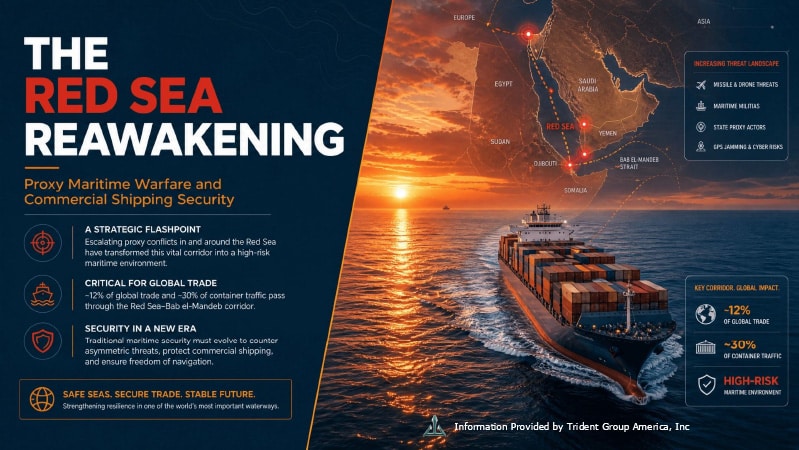
The commercial consequence of the Houthi campaign’s two-year duration represents the most significant enforced restructuring of global trade routes since the closure of the Suez Canal during the 1967 Arab-Israeli War. At the peak of the disruption, container ship transits through the Suez Canal had fallen 90 percent from their pre-crisis baseline, with most major container lines — Maersk, MSC, CMA CGM, Hapag-Lloyd — rerouting their entire Asia-Europe services around the Cape of Good Hope, adding 10 to 14 days to voyage times and increasing fuel consumption and operational costs commensurately (DocShipper, 2025). Freight rates on the highest-volume Asia-Europe lanes spiked 200 to 400 percent at peak disruption before stabilizing at 25 to 35 percent above pre-crisis levels, with the rerouting adding $200 to $400 per TEU in fuel, crew, and operational expenses per voyage (DocShipper, 2025). The Suez Canal accounts for approximately 12 percent of total global trade and 30 percent of global annual container transport volume — making the effective closure of the corridor not merely a regional maritime problem but a systematic inflation driver for every economy dependent on the goods it carries (Frontiers, 2025).
The insurance market restructuring that accompanied the campaign has proven more durable than the shipping rate spike. Following the July 2025 sinkings, the additional war risk premium for a ship transiting the Red Sea surged to at least 0.7 percent of hull value, and Marsh McLennan’s Marcus Baker confirmed that insurance costs for a $100 million vessel jumped from approximately $300,000 to $1 million per voyage in the immediate aftermath of the Magic Seas attack — the first confirmed vessels sinking since December 2024 (BeInsure, 2025). When the October 2025 ceasefire took hold, premiums fell back to approximately 0.2 percent of hull value, the lowest level since November 2023, according to Marsh’s head of marine Marcus Baker — but Kpler’s analysis of insurance market dynamics concluded that “the path back to normalcy will be measured in quarters, not weeks, and why some level of elevated risk pricing may become permanent” (Hellenic Shipping News, 2025; Kpler, 2025, para. 1). BIMCO’s Chief Safety and Security Officer Jakob Larsen confirmed the asymmetry that now governs the insurance market: “We expect insurance rates to increase manyfold, and ships with business connections to US or Israel approaching the area are probably not going to be able to get insurance” if attacks resume — a statement that identifies the targeting logic the Houthis have established as a permanent feature of the corridor’s risk architecture regardless of the operational tempo at any given moment (GCaptain, 2026c). As of the first week of January 2026, Suez Canal traffic remained 60 percent below its pre-crisis 2023 baseline despite 100 consecutive days without a confirmed Houthi attack demonstrating that commercial operators have internalized the structural uncertainty of the corridor in ways that will not be reversed by a pause in attacks that the Houthis have explicitly conditioned on Israeli behavior in Gaza (GCaptain, 2026a).
Maersk’s Q4 2025 financial results provided the corporate balance sheet expression of this structural disruption: a $153 million loss in its Ocean division, its first quarterly loss in years, against a 2026 guidance range spanning from a $1.5 billion loss to a $1.0 billion profit, a range so wide as to constitute an acknowledgment that the company’s financial trajectory depends entirely on a geopolitical situation it cannot predict or influence (GCaptain, 2026c). Maplecroft’s political risk analysis documented the parallel disruption to transit fee revenue: reports that the Houthis may be collecting up to $180 million per month in illegal maritime transit fees from vessels seeking to avoid targeting by paying directly to the group, a figure that, if accurate, implies shipping companies were willing to pay an additional premium exceeding 50 percent of the Suez Canal transit cost rather than circumnavigate Africa (Maplecroft, 2025).
The Houthis’ November 11, 2025, suspension of maritime attacks was announced by newly appointed Chief of Staff Yousef Hassan Al Madani with an explicit conditionality that the industry cannot responsibly ignore: “We are closely monitoring developments and declare that if the enemy resumes its aggression against Gaza, we will return to our military operations deep within the enemy’s territory” (GCaptain, 2026a, para. 6). When U.S.-Israeli strikes on Iran began on February 28, 2026, the Houthis immediately issued renewed threats to resume maritime targeting and within days, CMA CGM announced that three of its Asia-Europe services which had resumed Suez Canal transits were reverting to Cape of Good Hope routing due to what the company described as a “complex and uncertain international context” (S&P Global, 2026). By early April 2026, the JMIC Advisory Note confirmed that while no Houthi maritime attacks had been verified, “there is no verified evidence that Houthi forces have resumed attacks on commercial shipping; however, their direct entry into the conflict increases the likelihood of renewed maritime disruption” assessed threat language that in any other operational context would generate immediate contingency planning activation, not routine monitoring (UKMTO, 2026).
The Washington Institute’s analysis of Houthi military logistics identified the specific threat capability that makes the ceasefire pause strategically unreliable: “Nothing suggests that the group can be deterred from targeting shipping. Only a significant degradation of the group’s capabilities could convince most shipping companies to return to the Red Sea. Given the Houthis’ range of attack options, including missiles, drones, fast boats, unmanned surface vessels, and sea mines, airstrikes alone are unlikely to deliver” that degradation (Maplecroft, 2025, para. 6). The U.S. military campaign that preceded the ceasefire, Operation Rough Rider, which ran from mid-March to early May 2025 at a cost exceeding $1 billion with thousands of bombs and missiles targeting Houthi infrastructure across northern and western Yemen, had no measurable effect on the group’s maritime attack capability, which resumed with the July vessel sinkings demonstrably undiminished (Maplecroft, 2025). The MARAD Advisory 2026-006’s automatic expiry date of September 22, 2026, is not a recovery timeline. It is an administrative parameter for an advisory that U.S. authorities assess will need to be renewed, because the threat it documents is structural rather than temporary.
The operational lesson of the Red Sea campaign for commercial operators is not that the Suez corridor is permanently closed. It is that the security posture required to operate in that corridor, and in any future corridor where a state-backed non-state actor deploys military-grade maritime interdiction capability, is categorically different from the security posture that the BMP framework describes. The Skuld maritime security analysis articulated what MARAD Advisory 2026-006 makes operationally explicit: vessels with U.S., UK, or Israeli associations face the highest risk, but “exposure extends beyond flag state — ships connected through ownership structures, charter arrangements, or even prior port calls in Israel may be considered potential targets” (Skuld, 2026). The implication for commercial operators is that security assessment in proxy warfare environments must begin not with the vessel’s physical protection posture but with its ownership, chartering, trading, and corporate affiliation profile, an intelligence function that requires continuous monitoring of the threat actor’s published targeting criteria and real-time analysis of whether those criteria apply to the specific vessel in question.
The RUSI analysis of the Houthi weapon systems identified the specific capability gap that no commercial security measure can close: a non-state actor in possession of anti-ship ballistic missiles, anti-ship cruise missiles, long-range drones, explosive unmanned surface vessels, and swarm attack coordination capability requires a military response to defeat, not a commercial security response to deter (RUSI, 2024). What this means for commercial operators is not that security investment is futile but that the decision framework for Red Sea transit has permanently changed: the question is no longer “what security measures do I need to transit safely?” but “what intelligence picture do I need before deciding whether to transit at all?” and that intelligence picture must account for the geopolitical conditions governing the threat actor’s current targeting posture, not merely the physical security capabilities of the vessel making the transit. The new BMP Maritime Security publication acknowledges this shift explicitly, moving the doctrinal focus toward threat and risk assessment as the primary function rather than vessel hardening, a structural reorientation that reflects the same lesson the Red Sea campaign taught in practice (BIMCO et al., 2025; Seatrade Maritime, 2025).
The Red Sea crisis permanently altered the threat landscape that commercial maritime security must address. Its most consequential contribution to the field is not the specific tactics the Houthis deployed, though the coordinated use of ballistic missiles, cruise missiles, aerial drones, and explosive unmanned surface vessels against merchant vessels represents a capability threshold that no non-state actor had previously demonstrated in sustained operations. It is the precedent that a non-state actor with state backing can functionally blockade a global chokepoint, sustain that blockade against a coalition of the world’s most capable naval forces for two years, and resume it at will whenever the political conditions it has specified are met. MARAD Advisory 2026-006 remains active. Suez Canal traffic remains 60 percent below its pre-crisis baseline. The Houthi capability, missiles, drones, unmanned surface vessels, is intact. And the Iran war that began on February 28, 2026 has placed the Houthis’ explicit resumption threat in an active regional escalation context. The security community that treats this as a pause has misread the situation. What the Red Sea campaign demonstrated is that the era of commercial shipping operating in contested maritime corridors with security frameworks designed for criminal pirates is over and that the doctrine, insurance architecture, and operational planning required for the environment that replaced it are only beginning to be built.
BeInsure. (2025, July 15). Insurance costs for Red Sea shipping soar amid renewed Houthi attacks. https://beinsure.com/news/insurance-costs-red-sea-shipping-soar/
BIMCO, ICS, IMCA, INTERCARGO, INTERTANKO, & OCIMF. (2025, March 31). Best management practices for maritime security (BMP MS). https://www.maritimeglobalsecurity.org/
DocShipper. (2025). Red Sea crisis update: Route alternatives and cost impacts. https://docshipper.com/shipping/red-sea-crisis-update-route-alternatives-cost-impacts/
Frontiers in Political Science. (2025, November 30). Environmental impacts of the Houthis’ attacks against commercial shipping in the Red Sea. https://www.frontiersin.org/journals/political-science/articles/10.3389/fpos.2025.1711643/full
GCaptain. (2026a, January 7). Suez Canal traffic stalls at 60% below normal despite 100 days without Houthi attacks. https://gcaptain.com/suez-canal-traffic-stalls-at-60-below-normal-despite-100-days-without-houthi-attacks/
GCaptain. (2026b, March 26). New MARAD advisory urges ships to disable AIS tracking in Red Sea as Houthi threat lingers. https://gcaptain.com/new-marad-advisory-urges-ships-to-disable-ais-tracking-in-red-sea-as-houthi-threat-lingers/
GCaptain. (2026c, March 2). Red Sea corridor slips back into crisis as Houthi threats resurface. https://gcaptain.com/red-sea-corridor-slips-back-into-crisis-as-houthi-threats-resurface/
Hellenic Shipping News. (2025, December 10). Maritime war risk premiums fall in Red Sea, rise in Black Sea amid changing security dynamics. https://www.hellenicshippingnews.com/maritime-war-risk-premiums-fall-in-red-sea-rise-in-black-sea-amid-changing-security-dynamics/
Insurance Business Magazine. (2025, August 1). Escalating Houthi attacks in Red Sea trigger new global supply chain and insurance challenges. https://www.insurancebusinessmag.com/us/news/marine/escalating-houthi-attacks-in-red-sea-trigger-new-global-supply-chain-and-insurance-challenges-544621.aspx
Kpler. (2025, November 27). Red Sea risk: Why maritime insurance won’t return to ‘normal’ anytime soon. https://www.kpler.com/blog/red-sea-risk-maritime-insurance
Maplecroft. (2025, August 19). War premiums, shipping risks spike as Houthi campaign intensifies. https://www.maplecroft.com/solutions/consulting/political-risk/insights/war-premiums-shipping-risks-spike-as-houthi-campaign-intensifies/
NorthStandard. (2026). Red Sea and Gulf of Aden: Security threat to shipping. https://north-standard.com/insights-and-resources/resources/news/red-sea-security-threat-to-shipping
Royal United Services Institute. (2024, January 10). Securing the Red Sea: How can Houthi maritime strikes be countered? https://www.rusi.org/explore-our-research/publications/commentary/securing-red-sea-how-can-houthi-maritime-strikes-be-countered
S&P Global. (2026, February 20). Red Sea shipping reopens, but renewed Houthi threats keep route uncertainty high. https://www.spglobal.com/market-intelligence/en/news-insights/research/2026/02/red-sea-shipping-reopens
Seatrade Maritime. (2025, March 31). Associations consolidate security best management practices. https://www.seatrade-maritime.com/piracy/associations-consolidate-security-best-management-practices
Skuld. (2026). Maritime security update: Gulf region / Strait of Hormuz and Red Sea. https://www.skuld.com/topics/port/port-news/asia/maritime-security-update-gulf-region–strait-of-hormuz-and-red-sea/
U.S. Maritime Administration. (2026, March 26). 2026-006: Red Sea, Bab el Mandeb Strait, Gulf of Aden, Arabian Sea, and Somali Basin — Houthi attacks on commercial vessels. https://www.maritime.dot.gov/msci/2026-006-red-sea-bab-el-mandeb-strait-gulf-aden-arabian-sea-and-somali-basin-houthi-attacks
UK Maritime Trade Operations / Joint Maritime Information Centre. (2026, April 12). Update 031 to JMIC Advisory Note: 01 March – 12 April. https://www.ukmto.org/-/media/ukmto/products/update-031—jmic-advisory-note-12-april_final.pdf
Washington Institute for Near East Policy. (2024, December 16). Houthi shipping attacks: Patterns and expectations for 2025. https://www.washingtoninstitute.org/policy-analysis/houthi-shipping-attacks-patterns-and-expectations-2025
Washington Institute for Near East Policy. (2025a, July 16). Lethal attacks show strengthened Houthi control over Red Sea transit. https://www.washingtoninstitute.org/policy-analysis/lethal-attacks-show-strengthened-houthi-control-over-red-sea-transit
Washington Institute for Near East Policy. (2025b). Is the Houthi threat a checkmate for U.S. military logistics? https://www.washingtoninstitute.org/policy-analysis/houthi-threat-checkmate-us-military-logistics