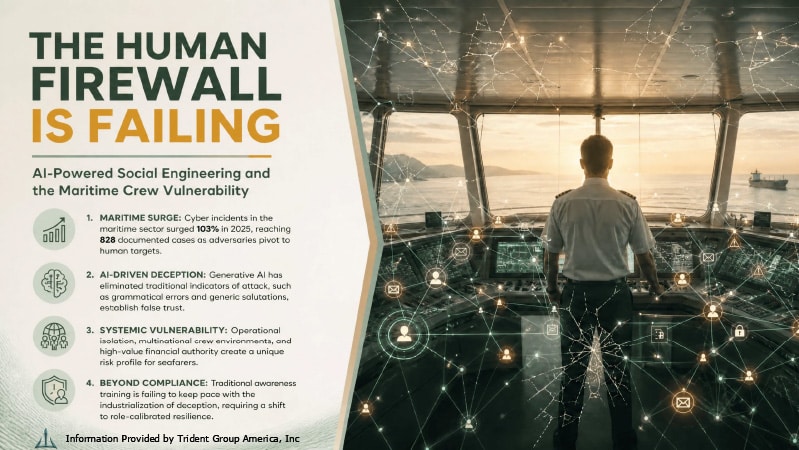

In early 2025, a European energy major’s accounts payable team received a call from what sounded exactly like the company’s Chief Financial Officer, including the voice, the accent, the cadence, and the sense of urgency, all precisely replicated. The caller authorized an immediate wire transfer of $25 million. The money was gone before anyone with the authority to question the instruction had been reached (Marine Insight, 2026). In a separate documented incident in the same period, a maritime operator’s crew compensation payments, funds designated for seafarers working aboard vessels at sea, were diverted through a compromised email account, with attackers intercepting payment instructions and substituting criminal accounts for the legitimate crew banking details (Smart Maritime Network, 2026). The wire transfer was processed. The crew members received nothing. These incidents are not isolated. They are representative of the fastest-growing attack vector in maritime cybersecurity: the human being at the keyboard, on the phone, or clicking the link. Maritime cyber incidents surged 103 percent in 2025, reaching 828 documented cases from 408 in 2024 and just 64 in 2020, an exponential acceleration that represents a fundamental shift in the threat environment the industry is navigating (Safety4Sea, 2026). The technical controls the industry has invested in over the past decade, network segmentation, VSAT encryption, OT system hardening, ECDIS security updates, address the attack vectors that sophisticated adversaries used before AI made human deception orders of magnitude cheaper, faster, and more effective. The adversary has pivoted. The industry’s defensive investment has not kept pace with the pivot.
The deployment of artificial intelligence in social engineering campaigns has not merely improved the efficiency of existing phishing and vishing techniques. It has fundamentally altered the threat model by eliminating the indicators that maritime crews were implicitly trained to recognize as signals of attack. Grammatical errors, the hallmark of hastily composed phishing emails assembled by non-native English speakers, are gone. Generic salutations that make no reference to the recipient’s specific role or current operational context are gone. Calls that hesitate, mispronounce names, or fail to reference the right operational details are gone. What has replaced them is correspondence and communication so precisely calibrated to the recipient that it bypasses the pattern-recognition that previous awareness training was designed to develop.
Cydome’s 2026 Maritime Cyber Trends Report, the most comprehensive sector-specific analysis of the current threat, documented that 83 percent of phishing emails now use AI to target multinational crews in their native language, crafting messages that establish trust through linguistic precision and contextual accuracy that manual social engineering cannot replicate at scale (Smart Maritime Network, 2026). This is not a marginal improvement in attack quality. It represents the industrialization of deception. AI tools that can generate thousands of individually tailored phishing emails in dozens of languages simultaneously, each one referencing the recipient’s specific vessel, their current port of call, their fleet manager’s name, and the operational detail that makes the email credible. KnowBe4’s analysis of 82.6 percent AI content across analyzed phishing emails, consistent with Cydome’s maritime-specific finding, confirms that this is not a maritime anomaly but the general direction of offensive social engineering across all industries, applied in the maritime context with specific exploitation of the crew’s operational vulnerabilities (USCS Institute, 2026). The MDPI maritime cybersecurity threat analysis, drawing on 112 incidents from the Maritime Cyber Attack Database between 2020 and 2025, concluded that “social engineering and manipulation remain common entry vectors for both sophisticated and opportunistic attackers,” compounded by “insufficient cybersecurity training, low digital literacy, and lack of situational awareness among crew and port staff”, a combination of tool quality and target vulnerability that creates exactly the conditions in which AI-powered social engineering thrives (MDPI, 2025).
The vishing dimension represents the most alarming single development in the current threat landscape. Voice phishing, the use of AI-cloned executive voices to authorize fraudulent financial transactions, surged 1,600 percent in the maritime context as documented by Cydome, a figure consistent with the broader 442 percent increase in vishing attacks globally across all industries driven by AI deepfake voice technology (Smart Maritime Network, 2026; SQ Magazine, 2026a). The specific capability that has made this possible is the dramatic reduction in the audio sample required to clone a voice convincingly: AI voice synthesis tools can now produce a persuasive voice clone from as little as three seconds of source audio, a quantity available from any public LinkedIn video, conference recording, or earnings call (SQ Magazine, 2026a). A fleet manager whose voice appears in any publicly accessible recording is now a viable impersonation target for every vessel in their fleet. The $25 million deepfake CFO transfer documented in the Cydome report involved a voice clone of sufficient quality that trained finance professionals with regular contact with the CFO were deceived, and 70 percent of organizations that have conducted vishing simulation exercises have found that employees share sensitive information during simulated attacks, a baseline deception success rate that AI quality improvements only increase (SQ Magazine, 2026b).
The maritime workforce is not simply a random sample of the working population exposed to the same social engineering risks as office-based employees. It is a specific population whose operational conditions create a systematic vulnerability profile that sophisticated adversaries have identified and are actively exploiting. The Springer Nature comprehensive review of social engineering in maritime cybersecurity identified the foundational vulnerability precisely: “Performing social engineering attacks on maritime workers is simpler than on executives because of inadequate knowledge of crew members in handling cyber issues and insufficient IT infrastructure facilities” (Springer Nature, 2025, para. 4). This assessment understates the specific environmental factors that compound crew vulnerability beyond the baseline of limited cybersecurity awareness.
The isolation dimension is the most operationally significant. A crew member who receives a suspicious communication while in port can walk to the shipping office, call a colleague they know personally, or take advantage of the physical proximity to their organization’s infrastructure. A crew member who receives the same communication while at sea, weeks from the nearest port, on a communication system that is their only link to shore, is operating in a fundamentally different decision environment. The urgency that AI-generated phishing and vishing consistently embeds in its communications (“respond immediately,” “authorize within the hour,” “do not delay or the port clearance will be lost”) exploits the specific psychological pressure of isolation by removing the option of in-person verification that would resolve the uncertainty in any terrestrial context. The Springer Nature maritime shipping challenges analysis documented the structural factor that compounds this isolation: “reduction in the number of crew due to the automation of work processes” means that each remaining crew member carries more operational responsibility, works longer hours, and has fewer colleagues available for the informal cross-checking that catches suspicious communications before they become security incidents (Springer Nature, 2022).
The multilingual dimension adds a layer of complexity that AI-powered social engineering has specifically been designed to exploit. Commercial vessels operate with multinational crews, officers and ratings from the Philippines, India, Eastern Europe, Ukraine, Myanmar, and dozens of other seafaring nations working together on vessels where multiple languages are spoken and English serves as the operational bridge language. A phishing email that arrives in a Filipino crew member’s Tagalog, precisely replicated, contextually appropriate, mimicking the formatting of legitimate correspondence from the crewing agent, bypasses the additional cognitive filter that foreign-language communication previously provided (Smart Maritime Network, 2026). The Dualog analysis of maritime email threats identified the specific compounding risk that multilingual crew environments create: crew members accessing email from multiple devices and locations, vessel systems, personal smartphones on public WiFi in port, crew welfare internet connections, create an inconsistent security posture that attackers map and exploit, identifying the access point with the weakest controls for credential harvesting or malware delivery (Dualog, 2026).
The financial transaction authority dimension creates the highest-value target profile in the crew vulnerability landscape. Maritime operations require constant financial decisions: port disbursements, bunker payments, agency fees, crew compensation, spare parts procurement, and emergency repair authorizations. Junior officers who would have no financial authority in an equivalent shore-based role regularly make operational decisions with significant financial consequences, often under time pressure and without the approval workflows that corporate financial controls mandate for equivalent amounts on land. The Maritime Executive editorial analysis of social engineering attacks in maritime identified this as the specific vulnerability that business email compromise exploits most effectively: attackers who have compromised a shipping company’s email infrastructure, or who have constructed convincing spoofed domains, can insert themselves into existing financial communication threads and redirect payments with instructions that appear to come from the established correspondent, the port agent, the ship manager, the fleet accountant, rather than from an unknown attacker (Maritime Executive, 2021).
The documented incident record of AI-powered social engineering against maritime targets in 2025 and 2026 provides the operational specificity that aggregate statistics alone cannot convey. The Cydome 2026 report’s documentation of the $200,000 crew compensation diversion, in which a European energy major’s crew payment system was compromised through AI-enhanced email interception that redirected compensation payments designated for seafarers, illustrates the specific human cost of maritime social engineering that purely commercial loss figures do not capture (Smart Maritime Network, 2026). The seafarers whose compensation was diverted were at sea, unable to dispute the payment failure through any immediate channel, and dependent on an employer who was simultaneously trying to trace the diversion and manage the operational consequences of a workforce that had not received expected wages. The attack exploited the geographic, temporal, and communication barriers that define the maritime employment relationship.
The Cydome report also documented the case of a maritime firm that unknowingly hired an operative who used an AI-enhanced photograph and a stolen identity to pass four separate video interviews before attempting to infiltrate the company’s internal servers from a concealed location using a laptop farm, a case that illustrates how the identity fraud dimension of AI-powered social engineering extends beyond phishing emails into the recruitment and personnel management processes that determine who has access to maritime networks in the first place (Smart Maritime Network, 2026). The deepfake CFO wire transfer and the stolen-identity hiring case share a structural characteristic: they succeeded because the verification processes the organizations relied on, such as voice recognition, video interviews, and established email correspondence, were the specific channels AI had learned to replicate convincingly. The defensive posture assumed that those channels were reliable. AI has made that assumption incorrect.
The MDPI analysis of maritime cyber incidents documented the specific attack vector distribution that confirms the primacy of the human element: while OT compromise generates the highest risk score in the framework, social engineering and manipulation remain “common entry vectors for both sophisticated and opportunistic attackers,” with human factor vulnerabilities consistently identified as the pathway through which technically sophisticated attacks begin (MDPI, 2025). The DNV ShipManager ransomware began through third-party software access. The Lab Dookhtegan VSAT campaign began with compromised credentials. In each case, the technical attack required initial access and in the maritime context, initial access increasingly begins with a crew member or shore-side employee who clicked a link, responded to a credential harvesting email, or accepted an urgent financial instruction that arrived through a channel they had been trained to trust.
The Springer Nature social engineering review’s conclusion that “regulation should be introduced regarding the human element” and that “trainings and exercises should be introduced for vessels’ crew and port facilities’ staff” reflects the analytical consensus that currently exists across every serious treatment of maritime crew cyber vulnerability and it also reflects how far the industry’s actual training practice has fallen short of that consensus (Springer Nature, 2025). The USCG final cybersecurity rule’s January 2026 training deadline has passed. The question is not whether training exists, the compliance checkboxes are being ticked, but whether the training that exists is designed for the threat environment that 2026 has created, or for the threat environment of 2020 when the rule’s training requirements were drafted.
Effective crew cybersecurity training in the AI social engineering era requires four elements that standard compliance-oriented programs consistently omit. The first is threat-specific, role-calibrated content. A deck officer who authorizes bunker payments needs training specifically designed around the business email compromise scenarios that target payment authorization workflows, not generic phishing awareness content designed for office workers managing corporate email accounts. A rating who accesses crew welfare internet in port needs training specifically designed around credential harvesting on public WiFi and the malware risk of personal device use on vessel networks, not theoretical training about network security architecture. The Springer Nature review’s identification of “advanced cybersecurity training and education” as particularly important for “critical staff like watchkeeping officers or engineers” reflects the recognition that role-specific training is more effective than generic awareness content and that the most security-critical roles in maritime are precisely the ones that carry the highest social engineering targeting value (Springer Nature, 2025).
The second element is a simulation-based assessment rather than a knowledge-based test. An organization that assesses crew cybersecurity training by asking crew members whether they know what a phishing email looks like is measuring awareness, not resilience. SQ Magazine’s vishing statistics found that 70 percent of organizations report that employees share sensitive information during vishing simulations, information they would never voluntarily provide if asked in a knowledge assessment context (SQ Magazine, 2026b). The gap between stated awareness and operational behavior under pressure is the gap that adversaries exploit. Realistic simulation exercises, AI-generated phishing emails sent to crew accounts as tests, simulated vishing calls to shore-side financial staff, tabletop exercises that walk through specific social engineering scenarios relevant to the organization’s operational context, measure the gap that matters and provide the targeting data needed to improve training where it is actually needed.
The third element is pre-authorized verification protocols that remove the decision burden from individual crew members in high-pressure situations. The specific vulnerability that vishing exploits is the absence of a reliable out-of-band verification mechanism: a crew member who receives a call from someone claiming to be the fleet manager and authorizing an urgent payment has no way to verify the caller’s identity through the same channel used for the attack. Cydome’s recommendation, establishing pre-shared code phrases between shore management and vessel crews specifically for use in financial authorization calls, creates a verification layer that AI voice cloning cannot replicate because the code phrase is not public audio (Smart Maritime Network, 2026). The Jazz Cybershield deepfake analysis identifies dual-approval financial controls and out-of-band verification as the specific technical countermeasures that reduce the impact of social engineering at the point of financial transaction, controls that are standard in corporate banking environments and systematically absent from maritime financial workflows (Jazz Cybershield, 2026).
The fourth element is recognition that the MarineLink “Third Era” formulation identifies cybersecurity in the maritime domain as the defining principle of maritime security in 2026, and it is no longer an IT problem. It is a Safety of Life at Sea issue (MarineLink, 2026). A compromised email account that diverts crew compensation is a human welfare issue. A vishing attack that authorizes a fraudulent bunker payment is a financial crime. A phishing email that harvests the credentials of a port management system user is an infrastructure security issue. All of them begin the same way: with a crew member or shore-side employee who received a communication that appeared trustworthy and responded to it. Training that treats cybersecurity as an IT department responsibility has misidentified the location of the threat. The human firewall is the first and most important line of defense, and it is the line that AI has most comprehensively learned to circumvent.
The 828 maritime cyber incidents recorded in 2025, up from 64 in 2020, represent not simply more attacks but a fundamentally different category of attack against a target population that is specifically vulnerable to its most effective delivery mechanism. AI has solved the problem that previously limited social engineering’s effectiveness: the difficulty of crafting deceptive communications convincingly enough, at scale, in the right languages, with the right operational context, to defeat the pattern-recognition that awareness training had developed. 83% of maritime phishing emails now contain AI-generated content. Vishing attacks using cloned executive voices have surged 1,600 percent. A voice clone requires three seconds of source audio. The crew member receiving a call that sounds exactly like the fleet manager, requesting an urgent payment authorization while the vessel is mid-ocean and the bridge team is managing a watch change, is not facing a failure of technical controls. They are facing a social engineering attack of a sophistication and plausibility that the verification frameworks they were trained on were not designed to defeat. Closing the gap between the threat that exists and the training programs that address it is not primarily a technology problem. It is a human capital problem, one that requires organizations to treat the crew member as the primary security asset the industry needs to invest in, rather than the primary liability it needs to manage around.
References
Brightside AI. (2026). AI spear phishing in 2026: Statistics, trends and CISO action guide. https://www.brside.com/blog/ai-spear-phishing-2026-ciso-guide
Cydome / Smart Maritime Network. (2026, March 2). AI is placing maritime industry at greater risk of cyber-attack — report. https://smartmaritimenetwork.com/2026/03/02/ai-is-placing-maritime-industry-at-greater-risk-of-cyber-attack-report/
Deepstrike. (2025). Vishing statistics 2025: AI deepfakes and the $40B voice scam surge. https://deepstrike.io/blog/vishing-statistics-2025
Dualog. (2026, February 19). Stay ahead of emerging email threats at sea. https://dualog.com/stay-ahead-of-emerging-email-threats-at-sea/
Jazz Cybershield. (2026). Deepfake phishing attack 2026: How to defend your business now. https://blog.jazzcybershield.com/deepfake-phishing-attack-2026/
Marine Insight. (2026, March 4). AI technology is placing the maritime industry at greater risk of a cyber attack, reveals new data. https://www.marineinsight.com/shipping-news/ai-technology-is-placing-the-maritime-industry-at-greater-risk-of-a-cyber-attack-reveals-new-data/
MarineLink. (2026, March 9). Navigating the “Third Era” of maritime cyber risk. https://www.marinelink.com/news/navigating-third-era-maritime-cyber-risk-536724
Maritime Executive. (2021, March 5). Digital perils: Socially engineered attacks in maritime cybersecurity. https://maritime-executive.com/editorials/digital-perils-socially-engineered-attacks-in-maritime-cybersecurity
MDPI — Journal of Marine Science and Engineering. (2025, December 18). Maritime industry cybersecurity threats in 2025: Advanced persistent threats, hacktivism and vulnerabilities. https://www.mdpi.com/2305-6290/9/4/178
Safety4Sea. (2026, March 31). Overview of the maritime cyber landscape: Key challenges ahead. https://safety4sea.com/cm-overview-of-the-maritime-cyber-landscape-key-challenges-ahead/
Springer Nature. (2022). Overview of current international maritime shipping challenges from a cyber threat perspective. https://link.springer.com/chapter/10.1007/978-3-031-68372-5_24
Springer Nature. (2025). A comprehensive review of social engineering on maritime cybersecurity. https://link.springer.com/chapter/10.1007/978-3-031-87290-7_10
SQ Magazine. (2026a, April 7). AI voice cloning fraud statistics 2026: Alarming trends. https://sqmagazine.co.uk/ai-voice-cloning-fraud-statistics/
SQ Magazine. (2026b, March 30). Voice phishing statistics 2026: Startling data. https://sqmagazine.co.uk/voice-phishing-statistics/
USCS Institute. (2026). AI-powered phishing detection and prevention strategies for 2026. https://www.uscsinstitute.org/cybersecurity-insights/blog/ai-powered-phishing-detection-and-prevention-strategies-for-2026
Vectra AI. (2026, March 23). AI scams in 2026: How they work and how to detect them. https://www.vectra.ai/topics/ai-scams