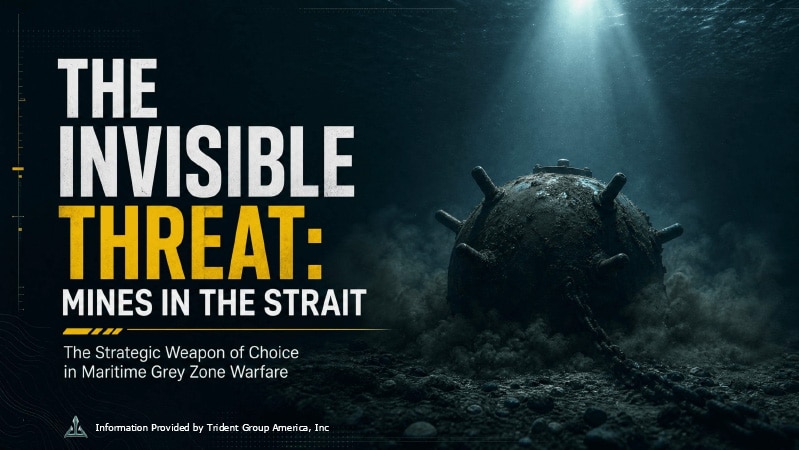

On February 28, 2026, within hours of U.S. and Israeli strikes commencing Operation Epic Fury, the Strait of Hormuz effectively closed, not because Iranian forces had physically blocked it, but because the global marine insurance market deemed the risk of transiting it unquantifiable. War risk premiums surged fivefold within 48 hours. All twelve members of the International Group of P&I Clubs, a risk pool covering 90 percent of the world’s oceangoing tonnage, issued 72-hour notices canceling certain war risk extensions. Lloyd’s Joint War Committee redesignated the entire Arabian Gulf, Gulf of Oman, and the waters of Bahrain, Kuwait, Oman, Qatar, and Djibouti as a conflict zone. Commercial vessel traffic collapsed by more than 80 percent before a single IRGC missile had struck a merchant ship (World Economic Forum, 2026; Small Wars Journal, 2026). Then the mines arrived. By late March 2026, U.S. intelligence assessments had confirmed at least a dozen Iranian-manufactured Maham-3 and Maham-7 naval mines deployed across sections of the strait, with subsequent reporting indicating the number had grown to 20 or more, as Iran continued to lay additional devices even as U.S. forces were actively attempting clearance (Gulf News, 2026; Axios, 2026; Washington Post, 2026). The International Energy Agency described the resulting supply disruption as the largest in the history of the global oil market, larger than the 1970s shocks (Axios, 2026). The Pentagon told the House Armed Services Committee in a classified briefing on April 22 that complete mine clearance could take six months (Washington Post, 2026). This essay examines what the Hormuz crisis has done to the commercial shipping security framework: what the mines are and why they are difficult to clear, how the insurance architecture collapsed and what has partially replaced it, what the IRGC’s operational pattern means for commercial vessels, and what a genuine Gulf security posture requires of operators with exposure in the region.
The Stimson Center’s definitive analysis of Iranian minelaying by Kelly Grieco and Marie-Louise Westermann, published March 23, 2026, established the deployment’s strategic logic with the clarity that only academic distance from the operational situation enables: “Naval mines are among the simplest and cheapest weapons in Iran’s arsenal — they are also among the most disruptive. Tehran’s mining threat to the Strait of Hormuz is designed to impose maximum costs by halting commercial traffic, raising oil prices, and forcing the United States into a slow, hazardous, and politically fraught clearance campaign. This is not an act of desperation. It is the deliberate execution of a strategy Tehran has refined since the tanker wars in the 1980s” (Stimson Center, 2026). The specific mine variants deployed, publicly identified by CENTCOM on April 11, 2026, following the first American warship transit since the crisis began, have technical characteristics that make them particularly resistant to the mine countermeasure systems the U.S. Navy has available in the theater.
The Maham-3 is a moored influence mine, meaning it is anchored to the seabed at a calibrated depth, using magnetic and acoustic sensors to detect passing vessels without physical contact, and analyzing movement patterns to select the optimal moment of detonation (Gulf News, 2026; CBS News via JPost, 2026). At over 660 pounds, it can attach itself to a vessel’s hull within ten feet of approach. The Maham-7, also described as a seabed bottom mine or “sticking mine,” is a 485-pound limpet-style device that rests on the bottom rather than floating at a fixed depth, a configuration specifically designed to scatter incoming sonar returns from the detection systems used by U.S. Avenger-class minesweepers, degrading the clearance system’s ability to locate and identify the device (House of Saud/CENTCOM analysis, 2026). CENTCOM’s April 11 announcement of active mine countermeasure operations confirmed the deployment of MH-60S Seahawk helicopters using the AN/ASQ-235 Airborne Mine Neutralization System, effective against moored mines like the Maham-3, and the Knifefish Unmanned Underwater Vehicle, built by General Dynamics specifically for shallow-water mine detection in cluttered environments, making its first deployment in a contested operational environment (House of Saud/CENTCOM analysis, 2026).
The clearance challenge is not simply technical. Iran declared a 1,400-square-kilometer “danger zone”, an area 14 times the size of Paris, where mines may be present, creating an area of uncertainty that dwarfs the precise location of confirmed devices (France24, 2026). The RAND Corporation’s Scott Savitz characterized the operational reality with precision: “There are still areas that have not been cleared from World War II, and in some cases, World War I, just because it is so resource-intensive and it takes a lot of time.” Dr. Steven Wills of the Center for Maritime Strategy at the Navy League added the compounding problem: Iran has between 2,000 and 6,000 naval mines in its stockpile, even after U.S. forces destroyed more than 44 mine-laying vessels in the first weeks of the conflict (PBS NewsHour, 2026; AOL/CENTCOM, 2026). The Stimson analysis captured the asymmetric leverage precisely: Iran does not need to lay an impenetrable minefield. It needs only to generate sufficient uncertainty about where mines are that commercial operators and their insurers cannot compute a rational transit risk, a psychological and actuarial effect that the Maham-7’s sonar-scattering geometry and the IRGC’s declared 1,400-square-kilometer danger zone have achieved far more effectively than any complete physical blockade could.
The Windward AI and Lloyd’s List analysis of the insurance market’s role in the Hormuz closure documents a dynamic that has permanently changed how commercial operators need to think about war risk coverage in contested maritime environments. The strait was commercially closed by the insurance market before the Iranian navy closed it physically. The sequence, the Small Wars Journal’s analysis termed the “actuarial blockade”, operated through three stages (Small Wars Journal, 2026). The first stage was premium repricing: additional war risk premiums for Gulf transits surged from 0.2 percent to 1 percent of hull value within 48 hours, adding approximately $800,000 per Very Large Crude Carrier voyage (Small Wars Journal, 2026; S&P Global, 2026). This raised costs dramatically, but did not halt traffic, and operators with sufficient margin could still absorb the increase. The second stage was coverage expiry: all twelve International Group P&I Clubs issued 72-hour cancellation notices for certain war risk extensions effective March 5, 2026, after which shipowners attempting to renegotiate were quoted rates described by Lloyd’s List as approximately $30,000 per week for coverage that previously cost $25,000 per year, a sixty-fold increase that produced the same practical outcome as outright refusal without technically constituting it (Small Wars Journal, 2026; Lloyd’s List, 2026). The third stage was the globalization of the exclusion: on March 8, the China Shipowners’ Mutual Assurance Association adopted JWLA-033, extending the conflict zone exclusion across Chinese-flagged and Chinese-insured tonnage (Small Wars Journal, 2026). Transit volume dropped from a seven-day average of 77 vessels to 4.
The LMA’s public statement in the week following the crisis onset provided important nuance that the headline narrative obscured: war risk insurance was technically still available within the Lloyd’s and London company market for vessels wishing to transit the Strait of Hormuz; liability coverage through the P&I Clubs remained non-cancellable and fully reinsured; and 88 percent of Lloyd’s marine war market participants surveyed continued to have appetite to underwrite international hull war risks (LMA, 2026). What had changed was not the availability of cover but its cost and conditionality, with premium terms differing according to each syndicate’s risk appetite, and the effective rate being sufficient to make transit commercially non-viable for most operators at prevailing freight rates. The World Economic Forum’s April 9 analysis documented the governmental response to this market failure: the Trump administration directed the U.S. International Development Finance Corporation to establish a $40 billion revolving reinsurance facility, effectively making the U.S. government the insurer of last resort for Gulf transits that the private market had priced at commercial non-viability (World Economic Forum, 2026).
The commercial shipping market’s response to the Hormuz crisis has been expressed most immediately in VLCC freight rates, meaning the price of chartering a very large crude carrier for a single voyage. The benchmark freight rate for VLCCs on the Middle East-to-China route hit an all-time high of $423,736 per day on March 3, 2026, a surge of more than 94 percent from the preceding Friday’s close, a level with no precedent in data going back to 2005 according to both LSEG and Baltic Exchange TD3C index data (CNBC, 2026; EIA, 2026; OilPrice.com, 2026). Baird Maritime documented the simultaneous LNG tanker rate explosion: daily rates for LNG carriers jumped more than 40 percent on March 3 alone, with Atlantic rates rising to $61,500 per day and Pacific rates to $41,000, driven by Qatar’s force majeure declaration on LNG contracts following the Hormuz closure (Baird Maritime, 2026). Breakbulk News’ March 26 analysis confirmed that over 150 tankers were anchored outside the strait, that vessels rerouting around the Cape of Good Hope were adding 3,500 to 4,000 nautical miles per voyage and 10 to 14 additional transit days, and that the supply squeeze had a mechanical floor: war risk insurance suspension for Gulf transits eliminated the option for rate-chasing vessels to enter the strait cheaply regardless of the freight premium available (Breakbulk News, 2026).
The IEA’s designation of the Hormuz crisis as the largest oil supply disruption in market history reflects the confluence of three simultaneous effects: the physical inability of vessels to transit due to mine and IRGC threat, the insurance market’s withdrawal of coverage at viable rates, and the absence of alternative routing capacity sufficient to replace the 20 million barrels per day that normally transits the strait (Axios, 2026). Saudi Arabia’s East-West pipeline reached its design capacity of 4.8 million barrels per day, covering less than a quarter of the normal Hormuz flow. The Houthis’ threatened resumption of Red Sea attacks closed the Suez-Red Sea alternative for vessels attempting to move Gulf crude to European markets. There is no corridor with equivalent capacity. This is not a situation where rerouting absorbs the disruption. It is a situation where the disruption cannot be fully absorbed until the Strait reopens.
The mine threat operates alongside, not instead of, the IRGC’s surface and aerial interdiction campaign against commercial shipping. The IRGC’s pattern of commercial vessel seizures has followed a consistent operational logic since at least 2019: target vessels with ownership, flag state, or cargo associations that Iran wishes to use as leverage in diplomatic or financial negotiations, execute seizures using fast attack craft and helicopter-borne boarding teams in the strait’s confined navigation channels, and hold vessels and their crews as bargaining assets whose release is conditioned on concessions that bear no legal relationship to the vessels or cargoes involved. The crisis following Operation Epic Fury intensified both the frequency and the geographic scope of this pattern, with the IRGC striking at least eight commercial vessels in the first weeks of the conflict using drones and fast attack boats in addition to the mine threat (Small Wars Journal, 2026). On April 12, Project Freedom, the U.S. military operation designed to escort commercial vessels through the strait, was initiated, with CENTCOM announcing that U.S. naval forces would intercept any vessels attempting to pay Iran’s declared toll for passage and would begin actively destroying mines (Navy Times, 2026).
The MIT/Foreign Affairs analysis by Caitlin Talmadge, published March 13, 2026, identified the specific mechanism through which even a small number of mines exerts disproportionate commercial impact: whether there are mines present or not, people think there are mines, and they will operate accordingly (MIT/Foreign Affairs, 2026). The psychological mine, meaning the declared danger zone, the uncertain number of devices, and the known difficulty of clearance, is operationally equivalent to the physical mine in its effect on commercial transit decisions. The Hapag-Lloyd spokesman’s April 2026 statement that the company was maintaining its non-transit position was not based on a specific identified mine in the traffic separation scheme. It was based on the rational commercial assessment that the Iran-declared 1,400-square-kilometer uncertainty zone was not compatible with the insurance conditions under which the company’s vessels could legally operate (France24, 2026).
The IRGC’s mine strategy specifically exploits the geometry of the Strait of Hormuz in ways that commercial operators and their security advisors need to understand. The strait is approximately 21 nautical miles wide at its narrowest point, with the internationally recognized traffic separation scheme (the two designated lanes through which commercial shipping is expected to transit) running approximately 2 miles wide in each direction. Mine deployment within or adjacent to this scheme creates precisely the threat concentration needed to affect the maximum proportion of transiting traffic with the minimum number of devices. The Stimson analysis documented the historical precedent: Iran mined the Strait and the Gulf of Suez during the 1980s Tanker War, in a conflict that the U.S. Navy ultimately managed through the Earnest Will convoy operation, but at the cost of significant damage to at least one U.S. warship, the USS Samuel B. Roberts, which struck an Iranian mine in 1988 (Stimson Center, 2026). The lesson Tehran drew from the Tanker War is that a determined minelaying campaign imposes costs far exceeding the investment in the weapons, and the 2026 deployment, with its sensor-equipped influence mines specifically designed to defeat the clearance systems deployed against them, reflects four decades of Iranian refinement of that lesson.
The operational lessons of the Hormuz crisis for commercial operators with Gulf exposure are specific and actionable, and they differ from the lessons of the Houthi Red Sea campaign in important ways that security planning needs to reflect. The Houthi threat was primarily a surface and aerial threat, addressed through armed security teams, vessel hardening, and rerouting decisions. The mine threat is invisible, unaddressed by conventional vessel hardening measures, and requires military assets for detection and clearance that no commercial security arrangement can replicate. The security posture adequate to the current Hormuz environment begins with an honest assessment of what commercial security can and cannot provide in a mined waterway.
Project Freedom’s naval escort architecture, formed of the U.S. Navy destroyers leading commercial vessels through the designated traffic separation scheme, provides the closest available equivalent to the Earnest Will convoy protection of the 1980s Tanker War, and operators whose vessels have been assessed as eligible for inclusion should engage with CENTCOM’s established process for participation (Navy Times, 2026). For vessels that cannot access a naval escort, the transit risk assessment must incorporate four variables simultaneously: the current mine clearance status of the specific route, the vessel’s insurance coverage confirmation and conditionality, the IRGC’s current targeting criteria, and the vessel’s flag state and ownership profile relative to those criteria. A vessel with a non-U.S., non-UK, non-Israeli flag state, no cargo associations with sanctioned entities, and confirmed war risk coverage at commercially viable rates faces a materially different risk profile from a U.S.-flagged tanker carrying Saudi crude with an Israeli-linked charterer, and pre-transit intelligence analysis that establishes this profile is the foundational security investment for any Gulf transit in the current environment.
The insurance gap requires direct attention before any transit decision is made. The LMA’s confirmation that coverage remains technically available provides a framework for operators, but the premium conditionality and the sixty-fold rate increase documented in Lloyd’s List mean that coverage that is nominally available may be commercially non-viable or structurally inadequate, with exclusion clauses for mine damage that may not be present in the standard policy wording but have been inserted in the renegotiated crisis-period coverage (LMA, 2026; Lloyd’s List, 2026). Legal review of the specific policy language by maritime law specialists before transit, not after an incident, is the minimum due diligence standard for Gulf operations in the current period.
Iran’s Hormuz mining campaign is not a desperate final measure by a state whose conventional military has been significantly degraded by U.S. and Israeli strikes. It is, as the Stimson Center characterized it, the deliberate execution of a strategy refined over four decades, one that leverages the mine’s unique characteristic of imposing maximum disruption at minimum cost, generating uncertainty that commercial markets convert into a closure more complete than any physical blockade Iran could sustain against U.S. naval power (Stimson Center, 2026). The Pentagon’s classified briefing estimate of six months for complete mine clearance, which was contested by the Pentagon’s own public affairs office, reflects the operational reality that mine clearance is the most resource-intensive and time-consuming naval operation in existence (Washington Post, 2026; PBS NewsHour, 2026). In the interim, Iran continues to lay additional devices; the declared danger zone covers 1,400 square kilometers, and the insurance architecture that normally underwrites Gulf transits has been repriced at rates that make commercial calculation approximately as difficult as Iranian mine deployment intended it to be. For commercial operators with Gulf exposure, this is not an acute crisis to be managed and then normalized. It is a structural demonstration that Iran possesses a repeatable, scalable playbook for closing the world’s most important energy waterway and that the security frameworks, insurance structures, and operational protocols required to operate in that environment demand systematic professional assessment, not reactive adjustment to headlines.
AOL / CENTCOM reporting. (2026). US destroys Iranian navy vessels — including 16 minelayers — near Strait of Hormuz. https://www.aol.com/iran-preparing-lay-mines-strait-203035813.html
Axios. (2026, April 23). Iran deploys more mines in the Strait of Hormuz, sources say. https://www.axios.com/2026/04/23/iran-strait-hormuz-mines-trump
Baird Maritime. (2026, March 3). Strait of Hormuz tensions send VLCC rates to all-time peaks. https://www.bairdmaritime.com/shipping/tankers/strait-of-hormuz-tensions-send-vlcc-rates-to-all-time-peaks
Breakbulk News. (2026, March 26). VLCC rates shatter all-time records as Hormuz blockade splits freight markets in two. https://breakbulk.news/vlcc-rates-shatter-all-time-records-as-hormuz-blockade-splits-freight-markets-in-two/
CBS News via Jerusalem Post. (2026, May 21). At least ten mines discovered in Strait of Hormuz, US intelligence says. https://www.jpost.com/middle-east/iran-news/article-896765
CNBC. (2026, March 3). Oil supertanker rates hit all-time high as insurers drop war risk protection in the Middle East. https://www.cnbc.com/2026/03/03/middle-east-crisis-iran-us-shipping-oil-tankers-strait-of-hormuz.html
France24. (2026, April 23). Pentagon denies clearing Hormuz Strait mines will take six months. https://www.france24.com/en/live-news/20260423-clearing-hormuz-strait-mines-could-take-six-months-report
Gulf News. (2026). Iran’s Hormuz trap: What to know about IRGC’s naval mines deployment. https://gulfnews.com/world/mena/irans-hormuz-trap-what-to-know-about-irgcs-naval-mines-deployment-1.500484573
House of Saud / Conflict Pulse. (2026, April 13). US names Iran’s Maham mines in Hormuz clearance op. https://houseofsaud.com/irgc-maham-mines-hormuz-clearance/
Lloyd’s List. (2026, March 8). No, P&I clubs have not ‘cancelled war risk cover.’ https://www.lloydslist.com/LL1156515/No-PI-clubs-have-not-cancelled-war-risk-cover
Lloyd’s Market Association. (2026, March 23). Safety concerns, not insurance availability, driving reduced vessel traffic in the Strait of Hormuz. https://lmalloyds.com/safety-concerns-not-insurance-availability-driving-reduced-vessel-traffic-in-the-strait-of-hormuz/
MIT Security Studies Program / Foreign Affairs. (2026, March 13). The Hormuz minefield. https://cis.mit.edu/news/hormuz-minefield
Navy Times. (2026, May 5). Pentagon assures safe passage through Strait of Hormuz despite presence of mines. https://www.navytimes.com/news/your-navy/2026/05/05/pentagon-assures-safe-passage-through-strait-of-hormuz-despite-presence-of-mines/
OilPrice.com. (2026, March 3). Iran war pushes Middle East oil tanker rates to all-time high. https://oilprice.com/Latest-Energy-News/World-News/Iran-War-Pushes-Middle-East-Oil-Tanker-Rates-to-All-Time-High.html
PBS NewsHour. (2026, April 25). U.S. says it’s clearing Iranian mines in latest push to open the Strait of Hormuz. https://www.pbs.org/newshour/world/u-s-says-its-clearing-iranian-mines-in-latest-push-to-open-the-strait-of-hormuz
S&P Global. (2026, March 6). Daily update: Hull war insurance premiums for vessels heading for the Gulf. https://www.spglobal.com/en/research-insights/market-insights/daily-update-mar-6-2026
Small Wars Journal. (2026, May 13). The insurance weapon: How commercial risk logic became an irregular warfare tool at Hormuz. https://smallwarsjournal.com/2026/05/13/the-insurance-weapon/
Stimson Center. (2026, March 23). Five things to know about Iranian minelaying. https://www.stimson.org/2026/five-things-to-know-about-iranian-minelaying/
The Defense News. (2026, March 24). US intelligence claim Iran deploys dozen Maham-3, Maham-7 naval mines in Strait of Hormuz. https://www.thedefensenews.com/news-details/US-Intelligence-Claim-Iran-Deploys-Dozen-Maham-3-Maham-7-Naval-Mines-in-Strait-of-Hormuz/
The Hill. (2026, April 23). Pentagon dismisses report it could take 6 months to reopen Strait of Hormuz. https://thehill.com/policy/defense/5845135-pentagon-denies-six-month-strait-hormuz/
U.S. Energy Information Administration. (2026, March 26). Middle East crude oil tanker rates reached a multi-decade high in March. https://www.eia.gov/todayinenergy/detail.php?id=67386
Washington Post. (2026, April 22). Clearing Strait of Hormuz of mines could take 6 months, Pentagon tells Congress. https://www.washingtonpost.com/national-security/2026/04/22/iran-hormuz-mines/
Windward AI. (2026, March 18). What role did marine insurers play in halting Hormuz traffic? https://windward.ai/blog/role-of-marine-insurers-in-halting-hormuz-traffic/
World Economic Forum. (2026, April 9). What stopping war-risk insurance in the Strait of Hormuz tells us. https://www.weforum.org/stories/2026/04/how-middle-east-war-turning-governments-into-insurers-last-resort/