
On March 7, 2026, the Philippine frigate BRP Miguel Malvar was on patrol near Sabina Shoal when the Chinese corvette Guang’an directed its fire control radar directly at the ship, a weapons-targeting action that in any other operational context would constitute an imminent act of war. Later the same month, a near-collision occurred near Thitu Island between a Chinese and a Philippine naval vessel, with both governments accusing the other of dangerous maneuvering. On April 9, the Philippine Coast Guard activated its first dedicated district command in the Spratly Islands, establishing a commodore-level commander permanently based on Pagasa Island, the most significant institutional investment the Philippines has made in its South China Sea presence since the BRP Sierra Madre was deliberately grounded on Second Thomas Shoal in 1999 (Stars and Stripes, 2026; Jakarta Post, 2026). On April 10 and 11, satellite imagery confirmed a 352-metre floating barrier installed by Chinese vessels across the entrance to Scarborough Shoal, accompanied by four fishing boats and a Chinese coast guard ship, blocking Filipino fishermen from waters that an international tribunal ruled in 2016 fell within the Philippines’ exclusive economic zone (International Crisis Group, 2026; Vision Times, 2026). On April 30, Chinese coast guard ships fired water cannons at Philippine maritime patrol vessels near Scarborough Shoal, with one vessel struck at approximately 1,000 yards from the shoal, suffering railing and canopy damage (UPI, 2026). The South China Sea in the spring of 2026 is not a slow-burning territorial dispute being managed through diplomatic channels. It is a weekly confrontation zone where Chinese state vessels, coast guard, maritime militia, and increasingly naval warships, are deploying a toolkit of coercive tactics calibrated to impose costs on the Philippines without triggering the formal threshold of armed conflict that would activate the US-Philippines Mutual Defense Treaty. For commercial shipping operators, the $3.4 trillion in annual trade that transits these waters is doing so through a corridor whose operational risk profile has fundamentally changed.
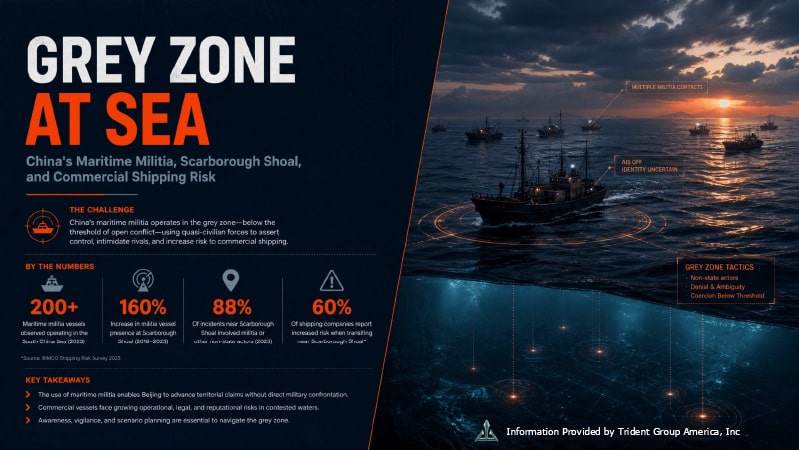
The strategic logic of China’s South China Sea approach is rooted in a doctrine that Western strategic analysts have termed “grey zone operations”, the deliberate use of coercive state action below the threshold of armed conflict to achieve territorial and political objectives that formal warfare would not achieve at acceptable cost (CRS, 2026). China’s primary instrument in this grey zone is the People’s Armed Forces Maritime Militia, the PAFMM, a force of nominally civilian fishing vessels that the U.S. Department of Defense has formally acknowledged operates under direct command and control of the People’s Liberation Army (Newsweek, 2025). The militia vessels, referred to by Philippine officials as “Little Blue Men” for their distinctive hulls, serve multiple simultaneous functions: they assert physical presence at disputed features in numbers that overwhelm the responding capacity of Philippine coast guard vessels; they provide intelligence, logistics, and communications support to Chinese coast guard operations; and they occupy contested waters for weeks at a time, establishing the pattern of continuous Chinese presence that Beijing treats as evidence of effective administrative control (Newsweek, 2025; CSIS, 2026).
CSIS’s Asia Maritime Transparency Initiative analysis of the 2025 PAFMM deployment documented a record number of militia vessels in the South China Sea, and identified a telling operational evolution: the majority spent most of their time anchored at China’s military outposts rather than operating from unoccupied reefs “where they might pretend to fish,” reflecting an assessment by Chinese authorities that they are no longer pressuring vessel owners to maintain the facade of the militia as a legitimate fishing fleet (Newsweek, 2025). The militia is no longer pretending to be a fishing fleet. It is operating as the paramilitary force that independent analysts and Philippine and U.S. officials have consistently assessed it to be. In the first week of January 2026 alone, Philippine Navy monitoring documented 41 Chinese vessels across four disputed features simultaneously: two warships, three coast guard ships, and three maritime militia boats at Scarborough Shoal; six coast guard vessels and eight militia ships at Second Thomas Shoal; three warships, six coast guard vessels, and four militia boats at Sabina Shoal; and four coast guard and two militia vessels at Thitu Island (MEXC/Manila reports, 2026). Philippine officials described this concentration as within the normal range, a characterization that illustrates how comprehensively the abnormal has become routine.
The specific tactics deployed against Philippine state vessels in 2025 and 2026 document the operational repertoire of grey zone maritime coercion with granular precision. Water cannons have been used against Philippine coast guard vessels on multiple documented occasions, damaging equipment, injuring crew members, and in the April 30, 2026 incident, striking two separate Philippine patrol vessels in a coordinated operation involving four Chinese coast guard and six maritime militia vessels simultaneously (UPI, 2026). Vessel obstruction, meaning positioning Chinese coast guard or militia ships to physically block the path of Philippine vessels attempting resupply missions to Second Thomas Shoal, has been documented continuously since 2023, with China’s coast guard publicly characterizing the operations as “professional, standardized, legitimate and legal” (Washington Times, 2025a). Fire control radar illumination of Philippine naval vessels in the March 7 Guang’an incident represents an escalatory step beyond physical harassment into the domain of weapons-targeting behavior, with direct implications for the rules of engagement of any allied naval vessel operating in proximity (Stars and Stripes, 2026). The Philippine National Security Council’s April 2026 disclosure that laboratory tests had confirmed cyanide in bottles seized from Chinese maritime militia boats near Second Thomas Shoal in February, July, and October 2025, describing alleged sabotage that threatened reef stability and the Philippine Navy outpost aboard the BRP Sierra Madre, added a dimension to the militia’s operations that extends beyond coercion into what Manila characterized as deliberate environmental destruction (International Crisis Group, 2026).
The legal foundation of the Philippines’ position in the South China Sea is unambiguous under international law and entirely irrelevant to Chinese operational behavior. The 2016 Permanent Court of Arbitration ruling in The Philippines v. China established that China’s nine-dash line claim is “inconsistent with UNCLOS and without legal effect,” that Scarborough Shoal generates only a twelve-nautical-mile territorial sea rather than an EEZ, and that Chinese fishing and law enforcement activities in the Philippines’ EEZ had violated Manila’s sovereign rights (CRS, 2026). China has rejected the ruling, has never acknowledged it as a legal matter, and has continued to expand its physical presence across disputed features in direct contravention of every principle the tribunal established. The floating barrier installed at Scarborough Shoal on April 10-11, 2026, blocking Filipino fishermen from waters the tribunal specifically found they have the right to access, is not a response to legal uncertainty. It is a deliberate assertion that China’s physical control supersedes international legal determination (UPI, 2026; Vision Times, 2026).
U.S. Secretary of State Marco Rubio’s characterization of the nature reserve designation China announced for part of Scarborough Shoal as “yet another coercive move to advance sweeping territorial and maritime claims in the South China Sea at the expense of its neighbors” captures the pattern accurately (Yahoo News, 2026). The nature reserve designation, like the floating barrier, the fire control radar illumination, the water cannon deployments, and the PAFMM swarming operations, is a legal-administrative measure designed to create facts that complicate subsequent legal challenge. A feature designated as a Chinese national nature reserve, monitored by Chinese coast guard vessels, and physically closed to non-Chinese access by a floating barrier, is being administered as Chinese sovereign territory regardless of what international tribunals have ruled. This is the operational logic of grey zone coercion: use sub-threshold actions to accumulate administrative and physical control that would require a significant military response to reverse, while ensuring that no individual action clearly crosses the armed conflict threshold that would trigger a formal alliance response.
The August 11, 2025 incident near Scarborough Shoal established a threshold of physical consequence that previous grey zone confrontations had approached but not crossed. As the Philippine Coast Guard vessels Teresa Magbanua and Suluan, along with the supply ship Pamamalakaya, conducted a resupply mission, multiple Chinese coast guard and PLA Navy vessels maneuvered aggressively to obstruct and expel them. In the course of those maneuvers, a Chinese PLA Navy warship cut across the bow of a China Coast Guard cutter at high speed, initiating a collision that severely damaged the Chinese cutter, crushing its bow and generating a man overboard search operation that Philippine coast guard personnel observed from close proximity (Maritime Executive, 2025a; Maritime Executive, 2025b). The Chinese coast guard subsequently fitted its small boats at Scarborough Shoal with crew-served weapons, a development the Armed Forces of the Philippines characterized as a direct escalation of the militia’s offensive capability (Maritime Executive, 2025c). Two days after the collision, the Arleigh Burke-class destroyer USS Higgins sailed past Scarborough on a freedom of navigation operation, drawing formal Chinese protests (Maritime Executive, 2025c). The incident’s significance for commercial shipping operators is not its specific tactical outcome but its demonstration that the coordination failures inherent in grey zone operations, multiple Chinese state entities operating in close proximity at high speed, generate maritime safety hazards that are indiscriminate in their potential consequences for any vessel navigating the same waters.
The South China Sea carries an estimated $3.4 trillion in annual maritime trade, approximately one-third of global seaborne commerce, through lanes that transit the very features at which China and the Philippines are engaging in weekly confrontations (Maritime Executive, 2018). The Strait of Malacca, through which the majority of this trade enters and exits the South China Sea, is the second most strategically critical chokepoint in global maritime commerce after the Strait of Hormuz, and the Hormuz closure following Operation Epic Fury on February 28, 2026 has increased the strategic weight of the Malacca-South China Sea corridor significantly. Kpler’s MarineTraffic transit data for the first seven days of February 2026 documented approximately 440 commercial vessels per day transiting the Malacca Strait, including 39 crude oil tanker transits and 19 VLCC transits daily, figures that have increased as rerouting from Hormuz has intensified the corridor’s strategic importance (Kpler, 2026). Notably, the Kpler analysis itself references the direct operational overlap between the Malacca-South China Sea corridor and the Scarborough Shoal confrontation zone, identifying Chinese coast guard and militia vessels surrounding the shoal as a factor in the broader chokepoint risk picture facing commercial shipping (Kpler, 2026).
The commercial shipping risk implications of the South China Sea confrontation operate across three distinct dimensions that most standard maritime risk assessments have not yet fully integrated. The first is the risk of collateral involvement in a grey zone incident. The March 2026 near-collision between Chinese and Philippine naval vessels near Thitu Island occurred in waters through which commercial vessels transit routinely on routes between Northeast Asian ports and Southeast Asian destinations. Chinese coast guard vessels conducting obstruction operations against Philippine resupply missions are operating in the same geographic areas as commercial shipping lanes. A commercial vessel maneuvering to avoid a developing confrontation, or finding its radio communications disrupted by the communications harassment that Chinese vessels have employed against Philippine counterparts, is experiencing a maritime safety hazard generated by grey zone operations it has no role in and no authority to resolve. The August 2025 incident demonstrated directly that multi-vessel high-speed maneuvering in contested maritime environments generates collision risk that no party, Chinese, Philippine, or commercial, can fully control once it has been initiated (Maritime Executive, 2025a).
The second dimension is the port and crew security risk for vessels calling at Philippine, Vietnamese, or Malaysian ports in the current environment. The Philippines has declared a state of national energy emergency in response to the U.S.-Iran war’s disruption of global oil supplies, a designation that carries implications for port operations, security posture, and logistics infrastructure in ports that handle significant commercial volumes (Stars and Stripes, 2026). The activation of the Philippines’ first Spratly Islands coast guard command signals a deliberate escalation of Manila’s security investment in the region, with associated implications for the military and law enforcement activity levels that commercial vessels transiting or calling at Philippine ports will operate adjacent to. Chinese maritime militia vessels have been documented operating near Philippine port approaches and within EEZ areas that include commercial shipping lanes, with the capability to harass, obstruct, and interfere with vessel communications, creating direct operational risk for commercial traffic in the vicinity.
The third dimension is the longer-term routing and insurance risk that a deteriorating security environment generates across the corridor’s risk architecture. MARAD has not yet issued a specific advisory for South China Sea commercial shipping beyond its general awareness notices, as the confrontations have remained below the threshold that generated the MARAD advisories for the Red Sea and Gulf of Aden corridor. The trajectory of the confrontations documented in the first five months of 2026, fire control radar illumination, floating barriers, water cannon deployments, cyanide sabotage allegations, and a near-collision between warships, suggests that the threshold may be approached sooner than most commercial risk assessments have modeled. The insurance market that repriced Red Sea war risk from 0.07 percent to 0.5 percent of hull value within weeks of the escalation of the Houthis’ campaign has the analytical infrastructure to rapidly reprice South China Sea transits if a significant incident occurs (Maritime Executive, 2026). The question for commercial operators is not whether that repricing is coming. It is whether their risk management framework has incorporated the current trajectory of the confrontation into routing and insurance decisions being made now.
The Philippine Coast Guard’s April 9, 2026 activation of its first dedicated district command in the Spratlys is strategically significant beyond its immediate operational implications. A commodore-level commander permanently stationed on Pagasa Island, with a permanently assigned ship, additional response vessels, and specialists, replacing the previous arrangement in which the entire Spratlys was administered from Palawan, represents an institutional escalation of the Philippines’ commitment to its South China Sea position that reflects a government assessment that the confrontation is intensifying, not stabilizing (Jakarta Post, 2026). The associated infrastructure investments, dredging a deeper port at Pagasa to allow coast guard vessels to dock directly, raising substations on Kota and Parola islands to full station status, are multi-year capital commitments that signal Manila does not expect the confrontation to de-escalate on a timeline that would make them unnecessary (Jakarta Post, 2026). The dispatch of the first Japanese combat troops to the Philippines since World War II, part of the Japan-Philippines security cooperation framework designed to deter Chinese activity in the South China Sea, adds a multilateral dimension to the confrontation that extends its strategic implications beyond the bilateral China-Philippines dispute (Washington Times, 2026).
The regional coalition context that has formed around the Philippines’ resistance to Chinese coercion also includes Australia, the HMAS Toowoomba, which participated in the February 16, 2026 combined maritime activity with Philippine, U.S., and Canadian naval vessels near Scarborough Shoal and the United States, whose USS Dewey was photographed sailing in formation with the Philippine fleet in the same exercise (Stars and Stripes, 2026). The combined presence of U.S., Australian, Canadian, and Japanese military assets in close proximity to the confrontation zones at which Chinese grey zone operations are concentrated creates a multilateral dimension that China’s coercive tactics must account for and that commercial shipping operators need to incorporate into their South China Sea security assessments. An incident involving a Chinese grey zone operation and a coalition partner’s naval vessel in waters where commercial shipping is simultaneously transiting is no longer a theoretical scenario — the March 2026 near-miss involved Philippine and Chinese warships in an area routinely transited by commercial traffic.
The South China Sea’s trajectory in 2025 and 2026 describes a grey zone confrontation that has not yet crossed into armed conflict and that China’s calibrated coercive toolkit is specifically designed to manage below that threshold indefinitely. The 352-metre floating barrier at Scarborough Shoal, the fire control radar illumination of a Philippine frigate, the water cannon deployments, the cyanide sabotage allegations, and the record PAFMM presence across disputed features simultaneously are not the preliminary actions of a government preparing for war. They are the instruments of a long-duration strategy whose objective is the administrative consolidation of Chinese control over disputed features without the military cost of formal armed conflict. For commercial shipping operators, this strategic distinction matters less than its operational consequences: the South China Sea is a corridor in which the risk of collateral involvement in a grey zone confrontation, the disruption of communications and navigation in the vicinity of active coercive operations, and the longer-term insurance and routing implications of an escalating security environment are all measurable and growing. The industry’s risk frameworks, developed for a South China Sea where tensions were managed at a lower operational tempo, require updating for the environment that the first five months of 2026 have documented — one where warships nearly collide, radar locks weapons onto allied frigates, floating barriers physically close the entrance to disputed atolls, and 440 commercial vessels per day continue to transit the Malacca Strait into waters where the confrontation is playing out alongside them.
Center for Strategic and International Studies. (2026). Asia Maritime Transparency Initiative: South China Sea maritime militia annual deployment analysis. https://amti.csis.org
Congressional Research Service. (2026, March 4). The Philippines: Background and U.S. relations (IF10250). https://www.congress.gov/crs_external_products/IF/HTML/IF10250.html
International Crisis Group. (2026, April 17). South China Sea conflict tracker: April 2026. https://www.crisisgroup.org/asia-pacific/south-east-asia/south-china-sea
Jakarta Post. (2026, April 9). Philippines unveils new coast guard command in disputed South China Sea. https://www.thejakartapost.com/world/2026/04/09/philippines-unveils-new-coast-guard-command-in-disputed-south-china-sea.html
Kpler. (2026, April 22). From Hormuz to Malacca: The next chokepoint risk. https://www.kpler.com/blog/from-hormuz-to-malacca-the-next-chokepoint-risk
Maritime Executive. (2018). Strait of Malacca key chokepoint for oil trade. https://maritime-executive.com/article/strait-of-malacca-key-chokepoint-for-oil-trade
Maritime Executive. (2025a, August 11). Video: China Coast Guard and PLA Navy collide chasing Philippine cutter. https://maritime-executive.com/article/video-chinese-coast-guard-and-navy-collide-chasing-philippine-cg
Maritime Executive. (2025b, August 12). China Coast Guard appears to run MOB search after collision. https://maritime-executive.com/article/china-coast-guard-appears-to-run-mob-search-after-collision
Maritime Executive. (2025c, August 22). China Coast Guard up-guns its presence at Scarborough Shoal. https://maritime-executive.com/article/china-coast-guard-up-guns-its-presence-at-scarborough-shoal
Maritime Executive. (2026, March 1). Container lines adjust to new risks in Strait of Hormuz and Red Sea. https://maritime-executive.com/article/container-lines-adjust-to-new-risks-in-strait-of-hormuz-and-red-sea
Newsweek. (2025, June 19). US ally confronts “illegal” Chinese ship swarm in disputed waters: Video. https://www.newsweek.com/philippines-china-militia-ship-swarm-south-china-sea-2087890
Stars and Stripes. (2026, March 30). Warships from China, Philippines involved in near-miss in South China Sea. https://www.stripes.com/theaters/asia_pacific/2026-03-30/warships-philippines-china-south-china-sea-21225432.html
UPI. (2026, April 30). China fires water cannons at Philippine ships in South China Sea. https://news.yahoo.com/china-fires-water-cannons-philippine-090745654.html
Vision Times. (2026, April 20). China builds barricade at Scarborough Shoal, raising South China Sea tensions with Philippines. https://www.visiontimes.com/2026/04/20/china-builds-barricade-at-scarborough-shoal-raising-south-china-sea-tensions-with-philippines.html
Washington Times. (2025a, August 11). Two Chinese ships collide during harassment operation. https://www.washingtontimes.com/news/2025/aug/11/two-chinese-ships-collide-harassment-operation/
Washington Times. (2025b, August 22). Philippines condemning China’s swarm of forces near disputed shoal and vows to defend the territory. https://www.washingtontimes.com/news/2025/aug/22/philippines-condemning-chinas-swarm-forces-near-disputed-shoal-vows/
Washington Times. (2026, March 30). Chinese warships, jets conduct combat patrol near disputed South China Sea shoal. https://www.washingtontimes.com/news/2026/mar/30/chinese-warships-jets-conduct-combat-patrol-near-disputed-south-china/
Yahoo News. (2026). China accuses Philippines of ship collision near disputed Scarborough shoal. https://www.yahoo.com/news/articles/china-accuses-philippines-ship-collision-033826848.html