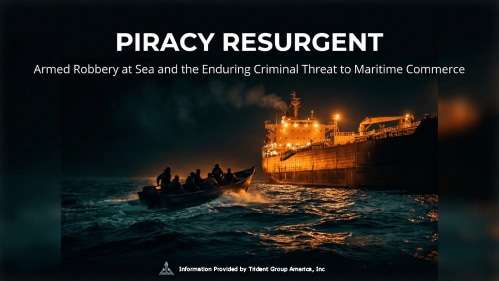

Today, much of the conversation about maritime security focuses on issues like state-backed hybrid warfare, sanctions evasion, and cyberattacks. As a result, some may think that piracy and armed robbery at sea are problems of the past, solved after the Somali hijacking crisis of the early 2010s thanks to naval patrols and industry best practices. However, 2025 data shows this view is mistaken. The ICC International Maritime Bureau (IMB) reported 137 piracy and armed robbery incidents in 2025, up from 116 in 2024 and 120 in 2023. Of these, 121 vessels were boarded, four were hijacked, and 25 crew members were kidnapped—more than double the 12 kidnappings in 2024 (ICC-IMB, 2026a). The Singapore Strait, a key shipping route that handles about 30 percent of global trade, saw its highest number of incidents since the IMB began tracking in 1991, making up 58 percent of all global cases (ICC-IMB, 2026a; GCaptain, 2026). Piracy has not gone away. Instead, it has changed, moved to new areas, and in some places, become even more dangerous. This essay looks at the current situation in the Singapore Strait, the Gulf of Guinea, and Somali waters, focusing on what drives these threats, their human and commercial impact, and how current responses are working—and where they are still falling short.
The biggest trend in 2025 piracy data is the sharp increase in armed robbery in the Singapore Strait and nearby Malacca Strait. In the first quarter of 2025, there were 27 incidents in the Singapore Strait, compared to just seven in the same period in 2024—a nearly fourfold rise (ICC-CCS, 2025a). By mid-year, 57 incidents had been reported in these waters, making up 63 percent of all piracy and armed robbery cases worldwide. Over the whole year, the region saw 80 incidents, up from 43 in 2024 (ICC-IMB, 2026a; Safety4Sea, 2025). The International Maritime Bureau stated clearly that the Singapore Strait is “a critical shipping route, with ships carrying roughly 30 percent of global trade,” and the rise in incidents is “deeply concerning as it puts the safety of our seafarers and the security of international commerce at risk” (GCaptain, 2025, para. 5).
What sets 2025 apart from earlier crime waves in the Singapore Strait is not just the number of incidents, but the growing violence and use of weapons. Guns were reported in 27 incidents during the year, more than three times the eight gun reports in 2024. Fourteen crew members were taken hostage, and others were threatened, injured, or assaulted (ICC-IMB, 2026a). Pirates have also started targeting larger ships, including supertankers over 150,000 deadweight tonnes, which were once thought to be safe from small-boat attacks common in Southeast Asia (Travel and Tour World, 2025). In one especially troubling three-day stretch in March 2025, six vessels were attacked. Maritime Fairtrade reported a 385 percent jump in incidents compared to the same period in 2024, disrupting about 420,000 TEUs of cargo movement (Maritime Fairtrade, 2025).
The group responsible for the rise in piracy is well-organized. When the Indonesian Marine Police arrested 11 suspected pirates in the Riau Islands in July 2025, investigations revealed that organized gangs were operating from Indonesian waters. They used the complex geography of the Singapore Strait’s southern approaches, with shallow, reef-filled waters, to launch attacks and escape quickly (ICC-IMB, 2026a; GCaptain, 2025). These arrests had an immediate impact: the IMB reported a sharp drop in incidents in the second half of 2025. This shows how organized these networks are and how effective targeted law enforcement can be when Singapore, Malaysia, and Indonesia work together and share intelligence (ICC-IMB, 2026a). The ReCAAP Information Sharing Centre, which coordinates anti-piracy efforts in Asia, named the Malacca and Singapore Straits as its main concern for 2025. These waterways saw 80 incidents in the first half of the year, compared to 21 in the same period in 2024 (GCaptain, 2025).
The Gulf of Guinea shows a more complex situation. The number of incidents has dropped a lot since the late 2010s, when this region became the world’s most dangerous area for crew kidnappings, overtaking Somali waters. In 2025, there were 21 incidents, a slight increase from 18 in 2024 but still much lower than past highs. This drop is due to real improvements, such as better cooperation through the Gulf of Guinea Maritime Collaboration Forum, stronger national navies, and better industry practices (ICC-IMB, 2026a). However, the lower number of incidents hides a serious problem: the Gulf of Guinea was responsible for 87 percent of all crew kidnappings worldwide in the first half of 2025. Fourteen crew members were kidnapped in the first six months, and 23 over the whole year in just four incidents. Attackers also showed they can target ships far from shore, not just near the coast (ICC-IMB, 2026a; Safety4Sea, 2025).
The IMB’s September 2025 report highlighted that a product tanker was boarded 46 nautical miles off the coast of Ghana in late August. All 13 crew members were safe, but the incident showed that Gulf of Guinea criminal groups can operate far from shore (ICC-IMB, 2025b). In March 2025, pirates hijacked a bitumen tanker southeast of São Tomé and Príncipe and kidnapped 10 crew members. This attack happened in an area not usually targeted by pirates, leading analysts to worry that strong enforcement in traditional hotspots is pushing crime into new waters (ICC-CCS, 2025a). This “balloon effect,” where cracking down in one area causes crime to pop up elsewhere, is a long-standing challenge in anti-piracy work and has been reported by Fox News in the broader context of African maritime security (Fox News, 2023).
The human cost of piracy in the Gulf of Guinea mostly affects international seafarers, often from the Philippines, India, or other Asian countries, who work on the targeted ships.
Kidnapping for ransom is the main criminal activity here. Victims are usually held on land in Nigeria or nearby countries while negotiations take place. Ransom demands can reach millions of dollars, and people may be held for weeks or even months. The psychological impact on victims and their families, as well as the effect on recruiting new seafarers for ships in West Africa, are real costs that do not show up in statistics but have a big impact on the region’s maritime industry and the well-being of its workers.
The Somali piracy crisis of the late 2000s and early 2010s — in which criminal networks from the lawless Puntland and South-Central regions hijacked hundreds of vessels and earned hundreds of millions of dollars in ransoms — was brought under control by a combination of international naval patrolling under operations including EU NAVFOR Atalanta and Combined Task Force 151, the widespread adoption of vessel hardening measures and citadel protocols, and the use of privately contracted armed security teams aboard high-value vessels. The IMB’s 2025 annual report confirms that this deterrence architecture remains broadly effective: only a small number of incidents were reported off the Somali coast in 2025, and Somali piracy has not rebounded to the systemic levels of a decade ago (ICC-IMB, 2026a).
However, the key word is “broadly.” In November 2025, two incidents happened far from shore, showing that Somali pirate groups still have the ability to operate in deep water, acquire vessels, and use ransom as a business model, just as they did in the past (ICC-IMB, 2026a). In both cases, quick action by crews and naval forces stopped things from getting worse. Still, in the first half of 2025, 26 crew members were taken hostage from two fishing vessels and a dhow in Somali waters, with these incidents happening between February and March, before the Southwest Monsoon arrived to limit pirate activity (ICC-CCS, 2025a). The IMB stressed: “The lack of a broader resurgence in Somali piracy continues to reflect the strong deterrent effect of sustained naval presence”—a statement that makes it clear what could happen if these patrols were reduced (ICC-IMB, 2026a, para. 6). Ongoing political and budget pressures on EU and allied naval operations in the Indian Ocean, along with the shift of naval resources to the Strait of Hormuz and Baltic security in 2026, mean that keeping up these patrols is a real policy challenge.
In every region, the human cost of piracy and armed robbery in 2025 deserves attention on its own, apart from the business and strategic issues. The IMB’s 2025 data shows that weapons were found in 55 percent of reported incidents in the first nine months, with guns reported in 42 incidents for the year, up from 26 in 2024 (ICC-IMB, 2026a; ICC-IMB, 2025b). Twenty-five crew members were kidnapped in 2025—more than twice as many as in 2024—and 46 were taken hostage at some point during their trips (ICC-IMB, 2026a). Maritime Fairtrade has reported a big rise in post-traumatic stress disorder among seafarers who have faced piracy, noting that the mental impact of armed attacks and hostage situations lasts long after the event and makes it harder for the industry to recruit and keep workers (Maritime Fairtrade, 2025).
IMB Director Michael Howlett put it simply: maritime trade “remains a cornerstone of real economic activity and growth,” and the increase in incidents “highlights the importance of protecting seafarers and securing key shipping routes not only for crew safety, but for the stability of global supply chains and the economies that depend on them” (GCaptain, 2026, para. 4). The seafarers who travel through the Singapore Strait at night, anchor in West African ports, or pass through the Bab el-Mandeb are not just statistics—they are the people who keep the global economy running. Protecting them from crime is both a moral duty and essential for international trade.
Anti-piracy efforts have worked well in some cases, especially with the Somali deterrence model and the Indonesian Marine Police’s targeted arrests in the Singapore Strait. However, 2025 data shows there are still important gaps. The ReCAAP Information Sharing Centre, which gives real-time updates and analysis on piracy in Asia-Pacific, has urged all vessels to report incidents quickly. Delays in reporting make it harder to prevent more attacks and leave other ships at risk in the same area (ICC-IMB, 2026a). The IMB has often pointed out that under-reporting is a problem everywhere. The IMB Piracy Reporting Centre’s Director said, “timely reporting is key to preventing further incidents and protecting other vessels in the area”—a reminder that the 137 incidents recorded in 2025 probably miss many actual events, especially in the Singapore Strait, where ship operators worry about insurance and reputation if they report formally (ICC-IMB, 2026a).
The overlap between piracy and the wider maritime security crisis of 2026 adds more challenges. Naval forces that would usually patrol the Indian Ocean and Gulf of Guinea have been sent to higher-priority areas like the Strait of Hormuz, the Baltic, and the Red Sea. The Houthi ceasefire in May 2025 and the start of the Iran war in February 2026 have disrupted shipping across the Indian Ocean, causing ships to change routes and leaving gaps in enforcement. Criminal groups in Somali and West African waters may take advantage of these changes. Riviera Maritime Media’s analysis of 2026 threats pointed out that if Houthi attacks resume or the Red Sea faces more problems, Somali piracy could get worse as ships are diverted and enforcement resources are stretched thin (Riviera Maritime Media, 2025).
The 2025 piracy data is a clear warning that the progress made against piracy in the 2010s is not guaranteed to last. The record number of incidents in the Singapore Strait—a key route for 30 percent of global trade—shows that even the most important and closely watched sea lanes can be at risk when criminal groups organize and adapt. The ongoing threat of kidnappings in the Gulf of Guinea proves that fewer incidents do not mean seafarers are safe. The Somali deterrence model still works, but only because of continued naval patrols, which are not guaranteed as priorities shift. Piracy and armed robbery at sea are not just problems of the past. They are ongoing, changing crimes that thrive on weak governance, poverty, and lack of enforcement—and the 2025 data shows these problems are still present.
Fox News. (2023, March 28). African pirates hijack oil tanker, capture 16 crewmembers off Congolese coast.https://www.foxnews.com/world/african-pirates-hijack-oil-tanker-capture-16-crewmembers-congolese-coast
GCaptain. (2025, July 10). Singapore Straits piracy surges: Critical trade route faces 50% increase in maritime crime.https://gcaptain.com/singapore-straits-piracy-surges-critical-trade-route-faces-50-increase-in-maritime-crime/
GCaptain. (2026, January 21). Maritime piracy surges in 2025 as Singapore Straits emerges as world’s most dangerous waters.https://gcaptain.com/maritime-piracy-surges-in-2025-as-singapore-straits-emerges-as-worlds-most-dangerous-waters/
ICC International Maritime Bureau. (2025a, April). Pronounced spike in low-level crimes in Singapore Straits — Q1 2025 report. https://icc-ccs.org/pronounced-spike-in-low-level-crimes-in-singapore-straits/
ICC International Maritime Bureau. (2025b, October). Cautious optimism prevails despite uptick in reported maritime piracy attacks — Q3 2025 report.https://iccwbo.org/news-publications/news/cautious-optimism-prevails-despite-uptick-in-reported-maritime-piracy-attacks/
ICC International Maritime Bureau. (2026a, January 15). Global maritime piracy and armed robbery increased in 2025 — Annual report. https://iccwbo.org/news-publications/report/global-maritime-piracy-and-armed-robbery-increased-in-2025/
ICC International Maritime Bureau. (2026b). Spike in armed robbery incidents raises concerns for vital Singapore Strait trade route.https://iccwbo.org/news-publications/news/spike-in-armed-robbery-incidents-raises-concerns-for-vital-singapore-strait-trade-route/
Maritime Executive. (2025, October 15). Calls for vigilance due to rise in piracy and robberies in 2025.https://maritime-executive.com/article/calls-for-vigilance-due-to-rise-in-piracy-and-robberies-in-2025
Maritime Fairtrade. (2025, December 5). Singapore’s maritime security at risk: Rising piracy threatens global trade.https://maritimefairtrade.org/singapores-maritime-security-at-risk-rising-piracy-threatens-global-trade/
Riviera Maritime Media. (2025, December). 2026 maritime threats: Three seas predominant for incidents, salvage potential.https://www.rivieramm.com/news-content-hub/news-content-hub/2026-maritime-threats-three-seas-dominate-incidents-salvage-potential-87142
Safety4Sea. (2025, August 19). IMB: 50% increase in piracy incidents in first six months of 2025.https://safety4sea.com/imb-50-increase-in-piracy-incidents-in-first-six-months-of-2025/
Travel and Tour World. (2025, July 12). Singapore Straits piracy surges: Global trade route faces record 50% rise in maritime crime in 2025.https://www.travelandtourworld.com/news/article/now-singapore-straits-piracy-surges-global-trade-route-faces-record-50-rise-in-maritime-crime-in-2025-here-is-everything-you-need-to-know/