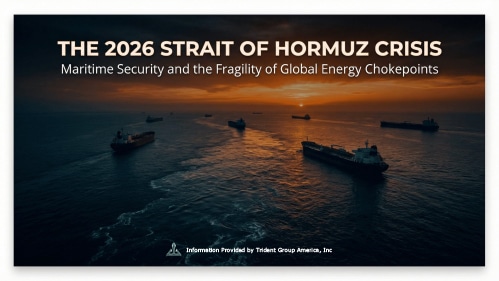

On February 28, 2026, the United States and Israel carried out coordinated airstrikes on Iran as part of Operation Epic Fury, hitting military sites, nuclear facilities, and senior leaders (Congressional Research Service [CRS], 2026). Within hours, Iran’s Islamic Revolutionary Guard Corps (IRGC) announced over maritime radio that the Strait of Hormuz was closed to hostile nations. The International Energy Agency called this the most severe disruption to the global energy supply in modern history (Council on Foreign Relations [CFR], 2026). The crisis quickly changed how governments, shipping companies, insurers, and energy importers approached security. This essay looks at the strait’s strategic importance, how the crisis began and escalated, its economic impact, the diplomatic and military responses, and what it means for maritime security in the long run. It argues that 2026 marked a turning point, showing how a maritime chokepoint can be weaponized on a scale not seen since the 1970s oil embargo.
The Strait of Hormuz is the world’s most important maritime chokepoint. At its narrowest, it is only 21 miles wide, with two shipping lanes just two miles across and a buffer zone in between. Despite its size, a huge portion of the world’s energy supply passes through it (Fox News, 2026a). About 20 million barrels of oil move through the strait each day, which is around one-fifth of global crude oil use, along with about 20 percent of all liquefied natural gas exports, mostly from Qatar (Fox News, 2026b; U.S. Energy Information Administration [EIA], 2026). The strait’s importance is not just about volume: Kuwait, Bahrain, Qatar, and Iraq have no other way to export their energy, so any disruption immediately puts their entire export capacity at risk.
The geography of the strait makes it especially vulnerable, and traditional military deterrence has not been able to solve this problem. The International Energy Agency (IEA) says that the only real alternatives—the Saudi East-West Pipeline and the UAE’s Abu Dhabi Crude Oil Pipeline—can together move only about 3.5 to 5.5 million barrels per day, which is much less than the usual amount (IEA, 2026). The EIA has warned that if oil cannot pass through a major chokepoint, even for a short time, it can cause big supply delays and higher shipping costs, which may raise global energy prices. Some chokepoints, they note, have no practical alternatives (EIA, 2026, para. 1–2). The Strait of Hormuz is a prime example. In 2026, this risk became a reality.
The crisis did not come as a surprise. Tensions between Iran, the United States, and Israel had been rising throughout 2025, especially after nuclear talks in Geneva failed and a 12-day military clash took place earlier that year (CRS, 2026). Just before the February 28 strikes, war-risk insurance premiums for ships passing through Hormuz had already jumped from 0.125 to between 0.2 and 0.4 percent of a vessel’s insured value per trip. For a very large crude carrier, this meant an extra cost of about $250,000, showing that the market recognized the growing risk (CRS, 2026).
After Operation Epic Fury, Iran responded quickly and escalated the situation at sea. Major insurers like Gard, Skuld, NorthStandard, the London P&I Club, and the American Club stopped offering war-risk coverage for Iranian waters and the wider Gulf, making it too expensive for most shipping companies to operate there (Fox News, 2026a). Big shipping firms such as Maersk stopped crossings altogether (Fox News, 2026a). By early March, the IRGC had carried out over 20 confirmed attacks on merchant ships using missiles, drones, and unmanned vessels (Washington Institute for Near East Policy [WINEP], 2026). Iran then did something new: it set up a “selective passage regime,” allowing ships from countries it considered friendly—like China, India, Pakistan, and Turkey—to pass, while blocking those from the United States, Israel, and their allies (Fox News, 2026b; WINEP, 2026).
Even more notably, Iran began to profit from its control of the strait. Iranian lawmaker Alaeddin Boroujerdi confirmed that Tehran was charging some tankers $2 million per trip, saying this showed “Iran’s strength” and was the start of a new “sovereign regime” over the strait (Fox News, 2026c). According to maritime intelligence firm Windward AI, by mid-March, only 16 ships with visible AIS signals crossed the strait in a week—a near-total collapse of normal traffic (Fox News, 2026c). Iran’s conditions for ending the war included making this “new legal regime for the Strait of Hormuz” permanent, directly challenging the international rule of freedom of navigation (WINEP, 2026).
The economic impact was immediate, severe, and felt around the world. Brent crude oil prices went over $100 per barrel for the first time in four years and peaked at $126, while energy markets in Asia and Europe were thrown into turmoil (CFR, 2026). Qatar stopped LNG production after Iranian strikes hit its gas facilities at Ras Laffan, and Saudi Arabia shut down a major refinery after a drone attack (Fox News, 2026a). Iraq cut back output as its storage filled up with oil that could not be exported, and Asian refineries reduced their production (Fox News, 2026a). The CFR pointed out that closing the strait could remove about 20 million barrels per day from the global oil supply—about 20 percent of the world’s petroleum liquids. For comparison, the 1973 Arab Oil Embargo removed only 4 million barrels per day, or 7 percent of global consumption at the time (CFR, 2026).
Economists at the Federal Reserve Bank of Dallas studied the wider economic effects and found that if nearly 20 percent of global oil supplies were cut off for a quarter, average WTI oil prices would rise to about $98 per barrel and global real GDP growth would drop by an annualized 2.9 percentage points (Federal Reserve Bank of Dallas, 2026). The United Nations Conference on Trade and Development (UNCTAD) warned that the effects went beyond energy, raising fertilizer and transport costs and threatening food security in vulnerable developing countries (UNCTAD, 2026). On a CNBC CFO Council call, business leaders said the market had about two weeks to resolve the crisis before oil prices would spike further and Asian industry would start to shut down. Energy expert John Kilduff warned that without a solution, “by the end of the year, even in the U.S., we’re going to have a major energy crisis on our hands” (as cited in CNBC, 2026, para. 9).
The disruption also affected other commodity markets. The strait is used to ship large amounts of helium, fertilizers, and industrial chemicals, so its closure threatened supply chains beyond just energy (CRS, 2026). The crisis also hit the shadow fleet of sanctioned tankers serving Russia, Iran, and China. Fox News reported that this could squeeze Russia’s war funding and put pressure on China’s industrial oil supply chains—an unintended result of Iran’s own actions (Fox News, 2026d).
The international response exposed deep fractures in Western alliance cohesion. On 19 March, the United States launched a dedicated military campaign to reopen the strait, deploying A-10 Thunderbolt II jets against Iranian fast-attack watercraft and AH-64 Apache gunships to counter drone attacks, while CENTCOM employed GBU-72 penetrator munitions against underground missile storage sites along Iran’s coast (WINEP, 2026). U.S. forces destroyed over 130 Iranian naval vessels and 44 minelayers, and dispatched the 31st and 11th Marine Expeditionary Units to the region alongside approximately 2,000 additional soldiers from the 82nd Airborne Division (WINEP, 2026; Fox News, 2026b).
On 21 March, President Trump issued a 48-hour ultimatum via Truth Social, warning that the United States would “hit and obliterate” Iran’s power plants, “starting with the biggest one first,” if the strait was not fully reopened (Fox News, 2026e). Iran responded by threatening to strike U.S. and Israeli energy infrastructure and desalination facilities across the region (Fox News, 2026e). By 23 March, the administration announced a five-day pause to allow diplomatic discussions, even as Tehran publicly denied that direct talks were underway (Fox News, 2026f). Energy Secretary Chris Wright signaled the U.S. was prepared to escort commercial vessels through the strait “as soon as it’s reasonable,” though Fox News reported that no convoy operations had yet been launched (Fox News, 2026b).
Trump’s parallel effort to assemble an international naval coalition met significant resistance. Germany, the United Kingdom, Japan, Australia, and the European Union declined to commit forces, with several allies citing opposition to the war itself. Twenty-two nations did eventually sign a joint statement expressing readiness to “contribute to appropriate efforts to ensure safe passage,” but stopped well short of deploying vessels (Fox News, 2026f). Meanwhile, Bahrain circulated a draft UN Security Council resolution condemning Iran’s attack on commercial vessels and authorizing member states to use “all necessary means” to secure freedom of navigation through the strait (Fox News, 2026f). Iran’s own negotiating demands — which a U.S. official described as “ridiculous and unrealistic” — included the closure of all American bases in the Gulf, lifting of all sanctions, permission to collect permanent transit fees, and the right to retain its full ballistic missile program (Fox News, 2026f).
The 2026 crisis has major implications that will influence maritime security policy for years. First, it showed that a determined regional power can cause huge problems for global trade using missiles, drones, and unmanned vessels, even against a much stronger military. Iran kept up its campaign for weeks against the world’s most powerful navy, and its 100-mile coastline with many launch sites made it very hard to fully stop the threat (WINEP, 2026). The key lesson for maritime strategists is that chokepoint geography gives countries leverage that military strength alone cannot always defeat.
Second, the crisis revealed that current alternative routes are not enough. The Saudi and UAE pipelines together can only handle 3.5 to 5.5 million barrels per day, which is less than a quarter of what usually passes through Hormuz (IEA, 2026). Sending ships around the Cape of Good Hope takes weeks longer and costs much more, especially with other disruptions in the Red Sea. Releases from strategic petroleum reserves by IEA countries only helped for a short time (CFR, 2026). Policymakers and energy planners now urgently need to invest in more bypass capacity, bigger reserves, and more diverse supply chains to match the risks shown by this crisis.
Third, commercial war-risk insurance coverage collapsed quickly, with major insurers pulling out within days. This move closed the strait to most commercial ships even before Iran attacked many of the vessels that turned back. Insurance markets are meant to spread risk, not handle shocks of this size. The U.S. government stepped in through the Terrorism Risk Insurance Act and the International Development Finance Corporation to support maritime trade insurance. This was a major, but mostly unnoticed, increase in government responsibility for shipping security (CRS, 2026).
Finally, Iran’s selective permitting system, which turned an international waterway into a politically controlled toll road, sets a troubling precedent in international law. Tehran wants this system to become a permanent “new legal regime for the Strait of Hormuz,” which challenges the basic rules of the UN Convention on the Law of the Sea (WINEP, 2026). If this is accepted in a settlement, it could encourage other coastal countries to take similar control over key waterways, threatening freedom of navigation far beyond the Persian Gulf.
The 2026 Strait of Hormuz crisis turned a long-discussed risk into the most important maritime security event of the decade. Within days, the world’s most vital chokepoint was nearly shut down, causing the biggest oil supply disruption ever recorded and clearly revealing how fragile global energy supply chains are. The crisis showed the limits of deterrence, alliances, and market-based risk management when a country is willing to use geography as a weapon. Whether the crisis ends through force, diplomacy, or simply wears out, the weaknesses it revealed—in bypass routes, reserves, insurance, and international law—need urgent attention from maritime security experts, energy planners, and policymakers. The strait was always called critical; now the world knows, at great cost, exactly why.
Congressional Research Service. (2026). Iran conflict and the Strait of Hormuz: Impacts on oil, gas, and other commodities (R45281). https://www.congress.gov/crs-product/R45281
Council on Foreign Relations. (2026, March 13). Iran, the Strait of Hormuz, and an unprecedented energy crunch. https://www.cfr.org/articles/iran-the-strait-of-hormuz-and-an-unprecedented-energy-crunch
CNBC. (2026, March 22). The economy has a Strait of Hormuz deadline for Trump: Two weeks. https://www.cnbc.com/2026/03/22/iran-war-strait-of-hormuz-trump-oil-prices-economy.html
Federal Reserve Bank of Dallas. (2026, March 20). What the closure of the Strait of Hormuz means for the global economy. https://www.dallasfed.org/research/economics/2026/0320
Fox News. (2026a, March 2). Strait of Hormuz grinds to a halt as Iran strikes rattle global energy markets. https://www.foxnews.com/politics/watch-shipping-through-strait-hormuz-grind-halt-amid-iran-conflict
Fox News. (2026b, March 7). Trump, Wright signal possible Navy escorts in Strait of Hormuz; none underway. https://www.foxnews.com/politics/us-signals-readiness-escort-tankers-through-hormuz-traffic-thins-no-mission-launched
Fox News. (2026c, March 22). Iran chokes Strait of Hormuz with reported $2M tanker toll, regime threatens global oil supply. https://www.foxnews.com/world/iran-chokes-strait-hormuz-reported-2m-tanker-toll-regime-threatens-global-oil-supply
Fox News. (2026d, March 6). Shadow fleet under fire: Iran’s strait shutdown could squeeze Russia’s war chest, China’s oil lifeline. https://www.foxnews.com/politics/shadow-fleet-under-fire-irans-strait-shutdown-could-squeeze-russias-war-chest-chinas-oil-lifeline
Fox News. (2026e, March 22). Trump gives Iran 48-hour ultimatum to reopen Strait of Hormuz: ‘Hit and obliterate.’ https://noticias.foxnews.com/live-news/us-iran-israel-war-latest-march-22
Fox News. (2026f, March 23–25). Live updates: Iran, Israel, U.S. war — Trump peace efforts and Hormuz diplomacy. https://www.foxnews.com/live-news/us-israel-iran-war-trump-peace-march-25
International Energy Agency. (2026). Strait of Hormuz. https://www.iea.org/about/oil-security-and-emergency-response/strait-of-hormuz
United Nations Conference on Trade and Development. (2026). Strait of Hormuz disruptions: Implications for global trade and development (UNCTAD/OSG/TT/INF/2026/1). https://unctad.org/publication/strait-hormuz-disruptions-implications-global-trade-and-development
U.S. Energy Information Administration. (2026). Amid regional conflict, the Strait of Hormuz remains critical oil chokepoint. https://www.eia.gov/todayinenergy/detail.php?id=65504
Washington Institute for Near East Policy. (2026, March 23). Military options for reopening the Strait of Hormuz: Limitations and imperatives. https://www.washingtoninstitute.org/policy-analysis/military-options-reopening-strait-hormuz-limitations-and-imperatives