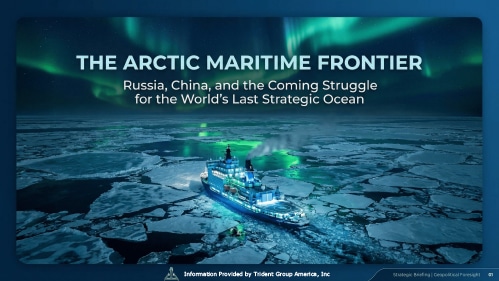

For most of maritime history, the Arctic Ocean was not a strategic domain — it was a barrier. Perpetual ice made it impenetrable to most surface vessels and irrelevant to global trade. That era is ending. Accelerating ice melt has opened the Northern Sea Route (NSR) along Russia’s Arctic coast and is gradually making the Northwest Passage along Canada’s northern shores seasonally navigable, reducing the shipping time between Asia and Europe to approximately two weeks — roughly half the transit time via the Suez Canal (CNN, 2026). The region sits atop half the world’s undiscovered oil and gas reserves and holds extraordinary concentrations of rare earth elements, critical minerals, and fisheries that will define the resource politics of the 21st century (U.S. Naval Institute [USNI] Proceedings, 2026a). Russia has been preparing for Arctic dominance for more than a decade, operating 32 military bases in the region and fielding a fleet of over 30 icebreakers, including seven nuclear-powered vessels (Fox News, 2025a). China, which has no Arctic territory but has declared itself a “Near-Arctic State,” has invested massively in icebreakers, Arctic shipping routes, and Russian energy partnerships under the rubric of the “Polar Silk Road” (USNI Proceedings, 2025). And the United States, which owns more Arctic coastline than any other NATO ally, has until recently treated the region as a strategic afterthought — a gap that the Trump administration and bipartisan congressional leadership are now racing to close. This essay examines the emerging Arctic maritime security challenge, arguing that the convergence of Russian militarization, Sino-Russian strategic cooperation, the icebreaker gap, and the legal ambiguity of newly navigable sea lanes has made the Arctic one of the most consequential and under-secured maritime frontiers of 2026.
The Arctic’s strategic importance is inseparable from its geography. The Northern Sea Route, hugging the Russian Arctic coastline from the Barents Sea to the Bering Strait, offers the most direct maritime link between the Atlantic and Pacific Oceans — a corridor that, if controlled or disrupted, could reshape global trade logistics for the same reason that the Suez Canal, the Strait of Hormuz, and the Malacca Strait matter: it is a chokepoint through which enormous economic value flows with no equivalent alternative at comparable cost (CNN, 2026). Beyond trade, the Arctic Ocean offers submarine access pathways of extraordinary military significance. The U.S. Naval Institute has documented in detail that a PLAN submarine operating in the Arctic would need ballistic missiles with a range of only 5,000 miles to reach virtually any point in the United States and Europe — a range China already possesses — and that, unlike the Atlantic where Russian submarines face persistent NATO surveillance, the Arctic gives submarines “more freedom to maneuver” (USNI Proceedings, 2025, para. 8).
The resource dimension compounds the strategic picture. Half of the world’s oil and gas reserves are estimated to lie beneath Arctic waters and permafrost (USNI Proceedings, 2026a). The region’s rare earth and critical mineral endowments are central to every advanced weapons system, battery technology, and semiconductor — resources that both Russia and China are actively positioning to control as part of their long-term strategic competition with the United States. Former DHS Secretary Kristi Noem wrote in a Fox News opinion piece that the U.S. is “already dependent on China’s shipbuilding and critical minerals industries, and the international scramble for the Arctic has opened the door for China to seize control of even more of the world’s mineral resources” (Fox News, 2025a, para. 5).
Russia’s Arctic strategy is the product of deliberate, long-term investment that began under Putin and accelerated significantly after the 2022 invasion of Ukraine made Russia’s western flank the focus of a grinding land war. The Northern Fleet, headquartered at Severomorsk on the Kola Peninsula less than 100 miles from the Finnish border, has been designated Russia’s primary strategic maritime force for Arctic operations, housing its nuclear-powered ballistic missile submarines (SSBNs) that underpin Russia’s second-strike deterrent capability (USNI Proceedings, 2026a). The Northern Fleet has been conducting expanded operations — in the Northern Commander’s own words, exercises designed to “rehearse repelling military threats and ensure the security of sea lanes and Russia’s areas of maritime economic activity in the northern seas in the event of a crisis” (as cited in USNI Proceedings, 2026a, para. 6).
Russia’s icebreaker fleet represents a capability asymmetry that has no NATO equivalent. With more than 30 diesel-electric icebreakers and seven nuclear-powered icebreakers, Russia can operate in Arctic waters year-round and at depths and speeds no Western power can match (Fox News, 2025a). This fleet enables not only commercial Arctic shipping — through which Russia is already exporting natural gas and oil directly to China via the NSR — but also military logistics and submarine deployment across the entire Arctic basin. Russia has also been constructing new Arctic military bases at a pace consistent with long-term strategic planning, bringing the total to 32 as of 2025, with more under development (Fox News, 2025a).
China’s Arctic posture is more opaque than Russia’s but no less consequential. China has defined the Arctic as a “new security domain” and officially promotes the Polar Silk Road as an economic complement to its Belt and Road Initiative — framing Arctic investment as a commercial undertaking while military-civil fusion ensures that the same research voyages, seabed mapping operations, and icebreaker deployments that serve the Polar Silk Road simultaneously feed China’s strategic military programs (USNI Proceedings, 2025). Chinese Arctic voyages using Xue Long-class icebreakers yield oceanographic and acoustic data that inform nuclear submarine navigation and development (USNI Proceedings, 2025). The construction of the Tan Suo San Hao research vessel, completed in just 10 months, demonstrated China’s ability to develop Arctic-capable platforms on compressed timelines that Western planners routinely underestimate (USNI Proceedings, 2025).
NATO’s Supreme Allied Commander Europe, General Grynkewich, told Fox News in January 2026 that Russia and China were conducting “more and more joint patrols” north of Alaska and near Canada, and that Chinese icebreakers and research vessels in Arctic waters were operating “not for peaceful purposes” but “to gain a military advantage” (Fox News, 2026a). He identified the same pattern of coordinated authoritarian pressure visible in Ukraine, the Middle East, and the South China Sea: “In Ukraine, China funds the war effort, Iran supplies weapons and North Korea offers manpower. In the Arctic and the high north, we see a similar trend” (Fox News, 2026a, para. 4). In mid-2025, Russian and Chinese navies conducted a joint naval patrol in the North Pacific proximate to Alaskan shores, with one Russian strategist even publicly proposing regular Chinese basing of submarines at Russian Arctic ports (USNI Proceedings, 2026b).
The United States’ structural deficit in Arctic capability is one of the most significant maritime security vulnerabilities of the current era. While Russia operates more than 37 icebreakers across its nuclear and diesel-electric fleet, and China operates five, the United States has two heavy icebreakers — one of which, the Polar Star, is over 50 years old and requires annual maintenance interventions to remain operational (Fox News, 2025a). Senator Dan Sullivan of Alaska, the most prominent congressional voice on Arctic security, has repeatedly characterized this gap as a critical national security failure, noting in discussions with Fox News that the absence of a robust U.S. icebreaker presence allows Russian and Chinese activity to “surge near Alaska’s western flank” without effective counter (Sullivan Senate Office, 2025).
The Trump administration has moved to address this deficit more aggressively than any predecessor. The One Big Beautiful Bill allocated $4.3 billion for up to three new heavy Polar Security Cutters, $3.5 billion for new medium Arctic Security Cutters, and $816 million for lighter icebreaking vessels, with a stated goal of building 40 new icebreakers in total (Fox News, 2025a). The ICE Pact signed with Finland and Canada creates a shipbuilding consortium to share expertise and industrial capacity — an acknowledgment that no single Western nation can close the icebreaker gap alone at the pace required (Fox News, 2025a). This investment, while substantial, faces a long lead time: modern heavy icebreakers take roughly a decade to design, build, and commission, meaning the gap will remain acute through the late 2020s and into the 2030s.
President Trump’s repeated assertions that the United States must acquire Greenland — escalating from rhetorical suggestion in 2025 to an international crisis after he refused to rule out military force, before settling on a framework agreement announced at the 2026 World Economic Forum — have brought the Arctic’s geopolitical significance into sharp public focus (Quincy Institute, 2026). Greenland’s strategic importance is undeniable: it sits astride key sea and air lanes between North America and Europe, hosts Pituffik Space Base, playing a role in missile warning and space surveillance, and commands the approaches to both the North Atlantic and the Arctic Ocean (Fox News, 2026a). As the Quincy Institute noted, Trump’s Greenland rhetoric “underscored how easily great-power posturing can destabilize a region long characterized by diplomatic restraint and multilateralism” — and demonstrated that the Arctic is no longer insulated from the competitive dynamics reshaping every other major maritime domain (Quincy Institute, 2026, para. 5).
The practical security concern behind the Greenland posture is real regardless of one’s view of the diplomatic approach. Greenland’s location means that whoever controls it effectively commands the air and sea approaches to the Arctic. Russian submarines transiting from the Northern Fleet to the North Atlantic pass through the GIUK Gap — the Greenland-Iceland-United Kingdom gap — which NATO has historically monitored as its primary barrier to Russian submarine activity in the Atlantic. An increasingly ice-free Arctic creates additional transit corridors that bypass the GIUK Gap entirely, making Greenland’s strategic value for surveillance and maritime patrol even greater as the century progresses (USNI Proceedings, 2026b).
The rapid opening of Arctic sea lanes has created legal ambiguities that rival states are already exploiting. Russia claims sovereign control over the Northern Sea Route under domestic legislation, requiring foreign vessels to obtain permission and to use Russian icebreaker escorts — a position the United States and other Western powers reject as inconsistent with UNCLOS’s freedom-of-navigation principles (Quincy Institute, 2026). China has supported Russia’s position while pursuing its own commercial interests in Arctic transit, creating a Sino-Russian legal alignment against the Western interpretation of maritime law in the region. The Arctic Council, the primary multilateral governance forum for the eight Arctic states, has been effectively paralyzed since Russia’s invasion of Ukraine, with the seven Western members suspending their participation in most Council activities (Quincy Institute, 2026).
This governance vacuum means that as the Arctic becomes more commercially significant and militarily contested, it lacks the institutional framework to manage escalation, regulate shipping, or protect critical infrastructure. The Pentagon’s 2024 Arctic Strategy explicitly identified joint Russian Chinese military exercises as direct threats to U.S. freedom of navigation in the region, while congressional NDAA provisions have restricted U.S. funding for joint scientific or commercial Arctic projects with Russia and China — reflecting an assessment that the window for cooperative Arctic management has closed (Quincy Institute, 2026).
The Arctic is no longer a frozen sanctuary at the edge of strategic competition — it is rapidly becoming the next front in the contest between democratic and authoritarian maritime powers. Russia’s three-decade investment in Arctic military infrastructure, China’s systematic integration of the Polar Silk Road into its global strategic framework, and the two powers’ growing operational coordination in waters approaching Alaskan shores represent a challenge to U.S. and allied maritime security that has been consistently underestimated and underfunded. The icebreaker gap is real, the governance vacuum is real, and the legal ambiguities over Northern Sea Route sovereignty create exactly the kind of grey zone that adversaries have demonstrated, in every other maritime theatre, they are prepared to exploit. The Trump administration’s icebreaker investment program and alliance-building through the ICE Pact represent meaningful steps — but closing a 50-year deficit in Arctic capability requires sustained investment, allied coordination, and strategic clarity over a timeframe that transcends any single administration.
CNN. (2026, January 21). The great race for the Arctic: Why Russia, China and the US all have it in their sights. https://www.cnn.com/2026/01/21/world/arctic-race-security-trump-explainer
Fox News. (2025a, August 8). We cannot allow Russia and China to dominate the Arctic with a military buildup. https://www.foxnews.com/opinion/russia-china-trying-seize-control-artic-we-cant-let-them-succeed
Fox News. (2026a, January 13). Russia, China not in Arctic for ‘peaceful reason,’ top US commander says. https://www.foxnews.com/politics/us-commander-says-russia-chinas-arctic-patrols-not-peaceful-purposes
Quincy Institute for Responsible Statecraft. (2026, January 27). Restraint and diplomacy in Arctic policy: Cooperation amid U.S.-Russia-China tensions. https://quincyinst.org/research/restraint-and-diplomacy-in-arctic-policy-cooperation-amid-u-s-russia-china-tensions/
Sullivan, Senator Dan (Alaska). (2025). ICYMI: Sen. Sullivan talks Arctic security, Russia-China incursions and historic Coast Guard build-up with Fox News. https://www.sullivan.senate.gov/newsroom/press-releases/icymi-sen-sullivan-talks-arctic-security-russia-china-incursions-and-historic-coast-guard-build-up-with-fox-news
U.S. Naval Institute Proceedings. (2025, December). Naval intelligence and China’s Arctic submarine threat. https://www.usni.org/magazines/proceedings/2025/december/naval-intelligence-and-chinas-arctic-submarine-threat
U.S. Naval Institute Proceedings. (2026a, January). War in the Arctic? https://www.usni.org/magazines/proceedings/2026/january/war-arctic
U.S. Naval Institute Proceedings. (2026b, January). Russian and Chinese threats to Greenland and the new Arctic sea routes are low. https://www.usni.org/magazines/proceedings/2026/january/russian-and-chinese-threats-greenland-and-new-arctic-sea-routes