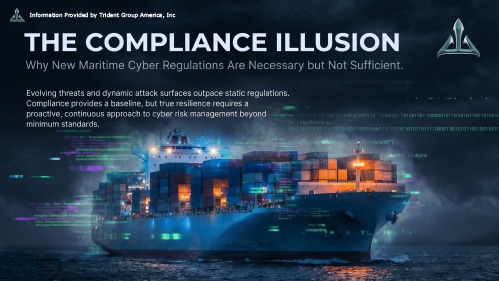

On July 16, 2025, the U.S. Coast Guard’s final rule on Cybersecurity in the Marine Transportation System took effect. This is the most comprehensive mandatory cybersecurity framework the American maritime sector has seen. Mandatory incident reporting to the National Response Center began immediately, and annual crew training requirements began in January 2026. By July 2027, companies must designate Cybersecurity Officers and submit formal plans to the Coast Guard. Alongside the International Association of Classification Societies’ Unified Requirements E26 and E27, which are mandatory for all new ships contracted after July 1, 2024, the maritime industry now operates under a regulatory system that would have been unrecognizable five years ago (Federal Register, 2025; Jones Walker, 2025; ABS Group, 2026). This progress is real, significant, and overdue. However, in today’s threat environment, it is not enough. The problem is not poor regulation design, but the sector’s tendency to equate compliance with true security. This essay argues that the gap between compliance and security is now the most serious vulnerability in global maritime cyber defense. Operators who see these new frameworks as the end goal, rather than a starting point, may only realize the difference after a breach.
To fairly judge maritime cyber regulations, we need to look at the threat data they are meant to address. In 2025, maritime cyber incidents rose by 103 percent from the previous year, going from 408 to 828 documented cases, according to CYTUR’s 2026 Maritime Cyber Threat White Paper, which is the most detailed dataset for the sector so far (Cyprus Mail, 2026; Navatom, 2026). Ransomware cases more than doubled to 372. Attacks on maritime Operational Technology, which controls engines, navigation, ballast, and cargo handling, increased by 150 percent. GPS spoofing incidents reached about 1,000 disruptions per day, affecting over 40,000 vessels. The average cost per incident now exceeds $550,000, and attacks that hit both IT and OT systems average $4.56 million when physical systems are compromised (Navatom, 2026; Industrial Cyber, 2026). The trend since 2020 is clear: CYTUR recorded only 64 incidents that year, but by 2025, the number had grown to 828 (Navatom, 2026). No regulatory framework developed over several years can keep up with a threat that is growing this quickly.
Cyber-attacks have changed in ways that compliance frameworks were not designed to handle. CYTUR’s analysis shows that AI agents can now perform up to 90 percent of an attack, from scanning for vulnerabilities to breaking into networks, moving within systems, stealing data, and destroying evidence, all without human involvement at each step (Shipping Telegraph, 2026). In January 2026, an AI model found 12 new zero-day vulnerabilities in OpenSSL, a software library that is closely monitored, including one that had been hidden for 15 years (Industrial Cyber, 2026). The time between a vulnerability being discovered and exploited has dropped to just 15 minutes in the most aggressive cases, while it still takes 15 to 30 days on average to patch critical vulnerabilities in maritime systems (Navatom, 2026). Regulations can require patches, but they cannot reduce the window in which attackers can exploit new weaknesses.
Understanding the compliance-security gap requires understanding precisely what the USCG’s July 2025 rule mandates, on what timeline, and to whom. The rule applies to U.S.-flagged vessels, Outer Continental Shelf facilities, and MTSA-regulated port facilities. It does not apply to foreign-flagged vessels operating in U.S. waters, though the Coast Guard has stated it will intensify Port State Control scrutiny of foreign vessels under ISM Code provisions as an indirect enforcement mechanism (USCG, 2025; ABS Group, 2026).
The phased rollout of the rule is important for understanding its current impact. As of July 16, 2025, the only immediate requirement was mandatory reporting of cyber incidents to the National Response Center. This was a major and overdue change from the old voluntary reporting system, but it is not a security control by itself (Jones Walker, 2025). Annual cybersecurity training became mandatory by January 12, 2026. More substantial requirements, such as appointing a Cybersecurity Officer, completing a Cybersecurity Assessment, and submitting a Cybersecurity Plan to the Coast Guard, do not take effect until July 16, 2027 (Blank Rome, 2025; Pen Test Partners, 2025). The USCG was also considering a two-to-five-year delay for U.S.-flagged vessels after industry feedback that the timeline was too demanding (Federal Register, 2025). In reality, some vessels may not have an approved, Coast Guard-reviewed cybersecurity plan until 2029 or later. By then, if current trends continue, the 828 incidents recorded in 2025 may seem like a small number.
The rule is expected to cost industry and government about $1.2 billion over 10 years, with most of that cost coming from cybersecurity drills, exercises, and penetration testing (Federal Register, 2025). Since training and testing make up the largest share of the cost, the most expensive parts of the rule are the processes, not the technical controls. An organization could pay for drills and prepare all the required documents, but if it leaves its network segmentation weak and its OT systems open to uncontrolled vendor access, it will meet the regulation on paper but still be at risk.
The IACS Unified Requirements E26 and E27 are the most significant maritime cybersecurity architectures developed by the classification society community. UR E26 treats the vessel as a complete “system of systems,” requiring network segmentation, access control, and a strict rule that no IP exposure exists between onboard systems and untrusted networks. This is a design-level security control that must be built in at the shipyard, not added later (Navatom, 2026; Speedcast, 2025). UR E27 takes this further by setting security requirements for individual sensors, PLCs, human-machine interfaces, and OT devices, and requires OEM equipment manufacturers to include security features like multi-factor authentication and fail-safe operational modes (ABS Group, 2026). In July 2025, classification societies including DNV issued major rule updates, introducing fleet-in-service pathways that create an “In-Operation” notation for existing vessels that voluntarily align their cyber posture with E26 and E27 principles (IACS UR E26 E27, 2026).
The main limitation of this framework is its scope. IACS E26 and E27 are only mandatory for ships contracted for construction on or after July 1, 2024 (ABS Group, 2026). The option for existing fleets to comply is available but voluntary. Most of the global commercial fleet consists of ships built before 2024, running on older systems designed for efficiency, not cybersecurity. These ships are not required to follow E26 or E27. They are only “strongly recommended” to adopt similar standards, but this recommendation has no enforcement, port state, or classification consequences unless the ship chooses to seek a cyber notation (ABS Group, 2026).
As maritime cybersecurity researcher Tony Shin noted, five major cyber incidents between 2023 and 2025, including the DNV ShipManager ransomware attack that hit 1,000 vessels and the DP World Australia attack that stopped operations at ports handling 40 percent of Australia’s container trade, showed that gaps in E26, especially around shore-based software and supply chain vulnerabilities, “translate directly into successful attacks with devastating operational and economic consequences” (Shin, 2025, para. 4). E26 was not in force during those incidents, but even if it had been, its design would not have stopped them, since attacks often come through channels the standard does not fully cover.
The difference between compliance and real security is not just a theory. Pen Test Partners’ work shows that vessels often fail on basic issues, not advanced threats, and these basics are the most likely to be overlooked when focusing only on compliance. Their assessments identified common problems, including unchanged default passwords on OT systems, vendor remote access with no time or logging controls, poor network separation between IT and OT, and incident response plans that do not align with actual conditions on board (Pen Test Partners, 2025). These weaknesses do not require skilled attackers to exploit, and all can pass a compliance audit if the paperwork is in order and drills are held. As Ship Universe’s compliance breakdown put it, most maritime teams “do not fail on ‘advanced cyber’, they fail on basics: unclear responsibility, uncontrolled vendor remote access, no restore proof, and a playbook that does not match real operations” (Ship Universe, 2026, para. 3).
The USCG rule is performance-based, meaning organizations have flexibility in how they meet compliance standards and only need to “demonstrate effectiveness in safeguarding operations” (Pen Test Partners, 2025). While this makes sense on the administrative side, it can lead to compliance theater. An operator can complete the required training, appoint a Cybersecurity Officer, and submit a solid cybersecurity plan, yet still run vessels with uncontrolled USB ports (which caused 75 percent of maritime malware incidents in 2024), VSAT connections without multi-factor authentication, and OT systems that share network access with crew welfare internet (Maritime Executive, 2025). The regulation requires a plan but does not require a penetration test to check if the plan works. As the CYTUR CEO put it, maritime cybersecurity “is no longer an option but a matter directly linked to a vessel’s right to operate”—and this applies to real security, not just having a compliance document (Cyprus Mail, 2026, para. 8).
Experts from CYTUR, Cydome, the NATO Cooperative Cyber Defense Center of Excellence, and Pen Test Partners agree on one main point: the maritime sector needs to move from reactive, compliance-based security to proactive, intelligence-driven resilience. This means treating regulations as the minimum standard, not the final goal. CYTUR’s framework suggests three key changes:
The Navatom ship management guide’s practical formulation captures what genuine security, as opposed to compliance, actually requires in operational terms:
These are not exotic requirements. They are the fundamentals that compliance frameworks mandate on paper, but that operational reality frequently undermines in practice. The EU’s NIS2 Directive, which classifies maritime shipping as essential infrastructure and imposes penalties of up to €10 million or 2 percent of global annual revenue for non-compliance, adds a financial accountability dimension that may prove more immediately motivating for board-level attention than the USCG’s phased implementation timeline (Navatom, 2026). The convergence of five simultaneous regulatory regimes — IMO MSC.428(98), USCG MTSA Cyber Regulations, IACS E26/E27, EU NIS2, and TMSA 3 Element 13 — is sending a coherent signal that the industry can no longer ignore. The question is whether operators receive that signal as an invitation to build genuine resilience or as a project management challenge to be administered toward a series of documentation deadlines.
The USCG’s July 2025 rule and the IACS E26/E27 framework represent the maritime industry’s most serious regulatory engagement with cybersecurity to date. They establish mandatory baselines, create accountability structures, and begin integrating cyber risk management into the same operational and legal frameworks as physical safety. These are genuine achievements. They are also frameworks designed for the threat environment of 2022 and being implemented on timelines that extend to 2027 and beyond, against a threat that recorded 828 incidents in 2025 and is doubling annually. The compliance illusion — the belief that completing a training module, designating a Cybersecurity Officer, and having a plan awaiting Coast Guard approval constitute a defensible security posture — is the most dangerous idea in maritime cybersecurity today. Regulations tell an organization what the minimum is. The adversary operates without reference to that minimum. The gap between those two standards is where breaches happen.
ABS Group. (2026). Cybersecurity compliance to IACS E26 and E27 regulations.https://www.abs-group.com/Solutions/Cybersecurity/Maritime-Cybersecurity/Maritime-Cybersecurity-Compliance-to-Industry-Regulations/Cybersecurity-Compliance-to-IACS-E26-and-E27-Regulations/
Blank Rome LLP. (2025, February 3). Cybersecurity in the marine transportation system: What you need to know about the Coast Guard’s final rule.https://www.blankrome.com/publications/cybersecurity-marine-transportation-system-what-you-need-know-about-coast-guards-final
Cyprus Mail. (2026, February 26). Maritime cyberattacks doubled in 2025, report finds.https://cyprus-mail.com/2026/02/26/maritime-cyberattacks-doubled-in-2025-report-finds/
Federal Register. (2025, January 17). Cybersecurity in the marine transportation system.https://www.federalregister.gov/documents/2025/01/17/2025-00708/cybersecurity-in-the-marine-transportation-system
IACS UR E26 E27. (2026, January 8). H2 2025 compliance landscape recap. https://ure27.com/e2627-2h2025-recap.html
Industrial Cyber. (2026, February 24). Maritime cyber incidents jump 103%, as CYTUR warns smart ships under fire.https://industrialcyber.co/reports/maritime-cyber-incidents-jump-103-as-cytur-warns-smart-ships-under-fire-urges-secure-by-design-overhaul/
Jones Walker LLP. (2025, July 16). New maritime cybersecurity era begins: Coast Guard rule takes effect.https://www.joneswalker.com/en/insights/blogs/perspectives/new-maritime-cybersecurity-era-begins-coast-guard-rule-takes-effect.html
Maritime Executive. (2025, November 15). Cyber proofing. https://maritime-executive.com/magazine/cyber-proofing
Maritime Innovations. (2026, January 29). Maritime cyber risk 2026 for fleet, compliance and insurers.https://maritime-innovations.com/maritime-cyber-risk-2026/
Navatom. (2026). Maritime cybersecurity 2026: Ship manager’s guide.https://navatom.com/blog/maritime-cybersecurity-2026-ship-managers-guide
Pen Test Partners. (2025). Maritime cybersecurity. https://www.pentestpartners.com/service/maritime/
Pen Test Partners. (2025, September 10). New mandatory USCG cyber regulations: What you need to know.https://www.pentestpartners.com/security-blog/new-mandatory-uscg-cyber-regulations-what-you-need-to-know/
Shipping Telegraph. (2026). ‘The era of disconnected seas is over’: Maritime cyber incidents in 2025 surged by 103%.https://shippingtelegraph.com/shipping-reports/the-era-of-disconnected-seas-is-over-maritime-cyber-incidents-in-2025-surged-by-103/
Shin, T. (2025, August 4). Why IACS UR E26 falls short of true maritime cyber resilience.https://medium.com/@shipsec.guardian/why-iacs-ur-e26-falls-short-of-true-maritime-cyber-resilience-33389da1ae6b
Ship Universe. (2026). 2026 maritime cybersecurity regulations: A simplified breakdown.https://www.shipuniverse.com/2025-maritime-cybersecurity-regulations-a-simplified-breakdown/
Speedcast. (2025). Cybersecurity IACS E26 and E27. https://www.speedcast.com/blog-hub/2025/iacs-e26-e27-standards/
U.S. Coast Guard. (2025, July 16). Final rule: Cybersecurity in the marine transportation system — implementation timeline.https://www.news.uscg.mil/maritime-commons/Article/4247529/final-rule-cybersecurity-in-the-marine-transportation-system-implementation-tim/