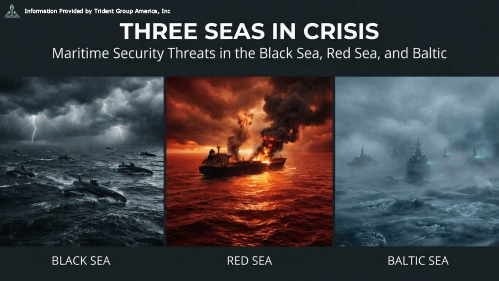

Commercial shipping has always faced risks, but the overlap of three maritime conflict zones in 2025 and 2026 is unprecedented in recent times. The Black Sea, Red Sea, and Baltic Sea have all become sites of state-backed and proxy attacks on commercial ships, with serious consequences for global trade, energy markets, and the international maritime order. This essay looks at each region, arguing that these simultaneous crises show a wider trend: authoritarian states, mainly Russia and Iran and their allies, are intentionally targeting global trade routes to apply strategic pressure. It also argues that while the West is starting to coordinate its response, it is still too fragmented compared to the organized nature of the threat.
The Black Sea is now the most active area for deliberate attacks on commercial shipping by state forces. What started as a fight between Ukrainian and Russian naval forces has turned into an ongoing campaign by both sides against commercial tankers, affecting more than just the countries involved. Ukraine’s Security Service (SBU) has openly said it uses Sea Baby unmanned surface vehicles (USVs) against Russian shadow fleet tankers, which it sees as legitimate military targets because they help fund Moscow’s war through oil exports that evade sanctions (Fox News, 2025a).
In late November 2025, Ukrainian naval drones struck the Gambian-flagged tankers Kairos and Virat in quick succession off Turkey’s Black Sea coast, prompting Turkish President Erdoğan to warn publicly that “the war between Russia and Ukraine has clearly begun to threaten navigational safety in the Black Sea” (The War Zone, 2025). Days later, the Russian tanker Midvolga-2, carrying sunflower oil from Russia to Georgia, was struck approximately 80 miles off Turkey’s Sinop coast (The War Zone, 2025). Then, in a significant expansion of Ukraine’s operational reach, the SBU struck the Oman-flagged Qendil — a shadow fleet tanker — with aerial drones in the Mediterranean, more than 2,000 kilometres from Ukrainian territory, marking the first time Kyiv had struck a Russian-linked vessel in that body of water (The War Zone, 2025b). The SBU stated explicitly: “Russia used this tanker to circumvent sanctions and earn money that went to the war against Ukraine. Ukraine will not stop and will strike it anywhere in the world, wherever it may be” (as cited in The War Zone, 2025b, para. 6).
Russia has answered by increasing missile and drone attacks on Ukrainian commercial port facilities, especially near Odesa. In December 2025, Russian UAVs hit a Turkish-owned ro-ro ship in Odesa harbor, and three more ships with Slovak, Palauan, and Liberian flags were damaged in later strikes on Odesa and Mykolaiv (Politics Today, 2026). This shows a pattern of both sides escalating: Ukraine targets Russia’s oil revenue at sea, while Russia strikes Ukrainian ports that are vital for its agricultural exports. Neither side seems willing to limit attacks to just military targets.
The conflict’s reach grew in March 2026, when the Greek-flagged tanker Maran Homer was hit by a suspected drone or missile in the Black Sea while waiting to load at the Russian port of Novorossiysk (Windward AI, 2026). The ship, managed by a U.S. company and traveling empty, was damaged but all 24 crew members were safe. Greek officials saw the attack as a possible response to U.S. decisions on Russian oil sanctions, showing how the conflict is now affecting commercial operators not directly involved in the war (Windward AI, 2026). Maritime security experts at Riviera Maritime Media predicted that Ukrainian attacks would increase, with Herminius adviser Dominick Donald saying Kyiv is “not wanting to cause an oil slick but are sabotaging vessels linked to the shadow fleet” and that “attacks will intensify in 2026” (Riviera Maritime Media, 2025).
Fox News Digital reported in December 2025 that the U.S. and Ukraine had worked together to target what analysts call a 1,000-vessel dark fleet of rogue tankers moving sanctioned Russian oil around the world. Maritime intelligence experts said that “there is a blurring of commercial and military shipping around the dark fleet,” a trend that has only “emerged in the last six or seven months” (Fox News, 2025a, para. 4–5). This means third-party commercial operators now face serious risks: any ship sharing routes, ports, or registries with shadow fleet tankers could be misidentified, caught in crossfire, or deliberately targeted.
The Red Sea became the world’s most dangerous shipping lane in late 2023, when Iran-backed Houthi rebels in Yemen began a series of missile and drone attacks on commercial ships, claiming to support Palestinians in Gaza. From October 2023 to the Gaza ceasefire in January 2025, the Houthis targeted over 100 merchant ships, sinking two, seizing one, and killing four sailors (Fox News, 2025b). These attacks led to a 90 percent drop in container shipping through the Red Sea between December 2023 and February 2024, according to the U.S. Defence Intelligence Agency, and forced major shipping companies to reroute around Africa’s Cape of Good Hope, adding about $1 million in fuel costs per trip (Fox News, 2025c). This $1 trillion trade route was effectively put under siege by a non-state group supported by a regional power, something not seen before in modern maritime history.
President Trump re-listed the Houthis as a foreign terrorist group and started Operation Rough Rider, a 50-day bombing campaign that hit over 1,000 sites in Yemen and led to a ceasefire in May 2025 (Fox News, 2025b). The ceasefire stopped Houthi attacks on U.S.-flagged ships, but the group quickly showed it did not plan to fully keep its promises. In October 2025, Fox News Digital reported that the Houthis attacked the Dutch cargo ship Minervagracht in the Gulf of Aden—the first major attack there since July 2024—killing one crew member and detaining ten UN workers from another ship (Fox News, 2025c). Ari Heistein, an analyst at the Foundation for Defense of Democracies, warned before the ceasefire that “compelling the Houthis to halt attacks on shipping is a meaningful achievement only if it is part of a broader, long-term strategy,” and cautioned that without strong pressure, the U.S. “could soon be confronting a more dangerous, better-armed terrorist group” (as cited in Fox News, 2025b, para. 6–7).
That warning turned out to be accurate. When the U.S.-Iran conflict began in late February 2026, the risk of renewed Houthi attacks quickly increased. Industry groups like Intertanko told members that “the expectation is that the Houthis may respond and recommence attacks on shipping” as tensions rose in the Gulf (Fox News, 2026a). Jakob P. Larsen, head of maritime security at BIMCO, told Fox News Digital that the Houthis had “threatened to resume attacks on ships in the Red Sea, Bab el-Mandab Strait and Gulf of Aden” in response to the Iran war (Fox News, 2026a, para. 8). The factors that allowed the Houthi campaign—such as Iranian weapons, Russian satellite data, and a Yemen-based launch platform with strong coastal surveillance—are still in place (Fox News, 2024). Military experts like Lt. Col. Eric Navarro from the Middle East Forum have said the ceasefire was mainly “a product of overwhelming pressure” and not a real change in Houthi intentions, warning that “I am always worried about groups like the Houthis sticking to anything they say” (as cited in Fox News, 2025d, para. 5).
The Red Sea is still a potential threat rather than a resolved one. The tools for renewed attacks—missiles, drones, coastal radar, and Iranian support—are still in place, and the political factors that could trigger new violence are beyond Western control.
The Baltic Sea shows a different but just as worrying situation. There is no open fighting, but tensions between Europe and Russia’s shadow fleet are rising and could lead to direct conflict. Russia uses the Baltic for about 60 percent of its seaborne crude exports. In November 2025, crude exports from Baltic ports rose 4.5 percent from the previous year, and petroleum product exports jumped 17.7 percent in the same period (United24 Media, 2026). By early 2026, almost half of the crude leaving Russia’s Baltic ports was carried by sanctioned ships, making shadow fleet traffic reach record highs (United24 Media, 2026).
Fox News Digital reported in January 2026 that NATO and Nordic-Baltic governments were increasingly worried about unauthorized people—described as “armed guards”—on shadow fleet tankers in the Baltic. Maritime intelligence analyst Michelle Wiese Bockmann said that “there is a blurring of commercial and military shipping around the dark fleet” (Fox News, 2026b). Investigative reports have confirmed this. The Organised Crime and Corruption Reporting Project (OCCRP) found that sanctioned Russian tankers on Baltic routes often left port with two-man “vessel protection teams” made up of Wagner Group veterans and GRU military intelligence agents. These teams were meant to stop European authorities from boarding or inspecting the ships (OCCRP, 2026). Such teams started appearing on Baltic routes around mid-2025 and were not seen on shadow fleet ships in the Black Sea or Pacific, suggesting a deliberate strategy (The Defence Post, 2026).
In January 2026, fourteen European countries—including Sweden, France, Germany, and the UK—issued a joint warning to shadow fleet operators. They said that ships without proper flags and documents would be treated as stateless under UNCLOS Article 110, allowing warships to board and inspect them in international waters (Insurance Journal, 2026). The Atlantic Council reported that when the Trump administration seized the Russian-flagged tanker Marinera in the North Atlantic in January 2026, it “flipped the initiative” against the shadow fleet, putting Moscow on the defensive and encouraging European countries to take stronger action (Atlantic Council, 2026). The Centre for European Policy Analysis (CEPA) also noted that Russian ships had been involved in drone launches that disrupted Danish airspace and in cutting cables in the Baltic Sea—examples of hybrid warfare using commercial cover (CEPA, 2025).
Riviera Maritime Media analysts warn that there is a risk of ongoing escalation. European countries are increasing inspections and disrupting traffic in the Baltic Sea to crack down on shadow fleet tankers, and Russia responds by targeting European critical infrastructure like undersea cables, pipelines, and offshore facilities (Riviera Maritime Media, 2025). This has already happened, with several cable damage incidents linked to Russian vessels as Europe steps up enforcement. The shadow fleet now serves as a tool for evading sanctions, gathering intelligence, conducting hybrid warfare, and possibly even direct attacks—a mix that European maritime laws and enforcement were not built to manage.
The strategic importance of all three conflict zones being active at once comes from how they interact and strengthen each other. Russia’s shadow fleet helps fund the Black Sea campaign and the conflict in the Baltic. Iran supports the Houthis, Russia provides satellite targeting to Houthi forces in the Red Sea, and Moscow also disrupts European maritime infrastructure. All of these actions show a coordinated challenge by authoritarian states to the Western-led maritime order (Fox News, 2024). Windward analyst Michelle Wiese Bockmann summed it up in January 2026: “It’s clear that shipping in 2026 is going to get darker. The number of vessels operating outside international rules-based order grows daily. The lines between commercial and military in shipping are increasingly blurred” (as cited in BBC Russia, 2026, para. 11).
Commercial shipping companies now operate in a world where neutral-flagged ships can be hit by naval drones far from any official conflict zone, port facilities can be destroyed by sudden missile strikes, and shadow fleet tankers with intelligence agents can pass through the English Channel openly. The long-standing separation between combat and commercial shipping, which has been the basis of international maritime law since the 19th century, is being steadily broken down.
The Black Sea, Red Sea, and Baltic Sea are not separate crisis areas—they are connected parts of a larger effort by authoritarian states and their allies to use global shipping as a tool for strategic pressure. Ukraine’s drone attacks on Russia’s shadow fleet, the Houthis’ ongoing anti-shipping operations, and Russia’s use of commercial tankers for military purposes in the Baltic all pose a serious threat to freedom of navigation and the neutrality of international shipping. To meet this challenge, the West needs more than just tactical responses to single events. It requires a coordinated maritime strategy that brings together sanctions enforcement, naval deterrence, legal changes, and intelligence sharing across all three regions at once. If each crisis is handled separately while adversaries work together, the result will be ongoing escalation.
Atlantic Council. (2026, January 22). The US is taking action against Russia’s shadow fleet. In the Baltic Sea, Europe should follow suit.https://www.atlanticcouncil.org/dispatches/the-us-is-taking-action-against-russias-shadow-fleet-in-the-baltic-sea-europe-should-follow-suit/
BBC Russia. (2026, January). The US has set its sights on shadow fleet tankers. What does this mean for Russia? https://bbcrussian.substack.com/p/shadow-fleet-tankers
Centre for European Policy Analysis. (2025, December 19). Preparing to confront Russia’s shadow fleet. https://cepa.org/article/preparing-to-confront-russias-shadow-fleet/
Fox News. (2024, October 25). Russia is supplying Houthis with satellite data to attack ships in the Red Sea. https://www.foxnews.com/politics/russia-supplying-houthis-satellite-data-attack-ships-red-sea
Fox News. (2025a, December 15). US and Ukraine target massive vessel dark fleet smuggling sanctioned oil worldwide. https://www.foxnews.com/world/us-ukraine-target-massive-vessel-dark-fleet-smuggling-sanctioned-oil-worldwide
Fox News. (2025b, May 8). Trump halts military strikes on Houthis but expert warns Iran-backed terrorist group remains major threat.https://www.foxnews.com/world/trump-halts-military-strikes-houthis-expert-warns-iran-backed-terrorist-group-remains-major-threat
Fox News. (2025c, October 8). Crew member dies after Houthi attack on Dutch cargo ship in Gulf of Aden. https://www.foxnews.com/politics/houthi-rebels-test-us-ceasefire-deadly-strike-cargo-ship
Fox News. (2025d, May 6). Experts split as Trump halts Yemen bombing campaign after Houthi ceasefire deal. https://www.foxnews.com/politics/white-house-calls-yemen-ceasefire-win-experts-warn-houthis-may-not-hold-line
Fox News. (2026a, March 1). Hormuz erupts: Attacks, GPS jamming, Houthi threats rock strait amid U.S.-Israeli strikes. https://www.foxnews.com/world/strait-hormuz-maritime-incidents-follow-us-israeli-operation-epic-fury-strikes-iran
Fox News. (2026b, January 8). NATO worried about dark fleet crews as US seizes Russian tanker. https://www.foxnews.com/world/irregular-armed-guards-russian-shadow-tankers-alarm-nordic-baltic-governments
Insurance Journal. (2026, January 27). European nations issue warning to Russia-linked shadow fleet. https://www.insurancejournal.com/news/international/2026/01/27/855788.htm
Organised Crime and Corruption Reporting Project. (2026). From Wagner to GRU, Russian military men are manning Moscow’s shadow fleet.https://www.occrp.org/en/investigation/from-wagner-to-gru-russian-military-men-are-manning-moscows-shadow-fleet
Politics Today. (2026, January 12). Attacks on merchant ships in the Black Sea: What law says. https://politicstoday.org/attacks-on-merchant-ships-in-the-black-sea-what-law-says/
Riviera Maritime Media. (2025, December). 2026 maritime threats: Three seas predominant for incidents, salvage potential.https://www.rivieramm.com/news-content-hub/news-content-hub/2026-maritime-threats-three-seas-dominate-incidents-salvage-potential-87142
The Defence Post. (2026, March 12). Russia using mercenaries, intel operatives to guard ‘shadow fleet’ tankers. https://thedefensepost.com/2026/03/12/russia-shadow-fleet-mercenaries/
The War Zone. (2025, December 2). Russian oil tanker struck in aerial attack hundreds of miles from Ukraine. https://www.twz.com/sea/russian-oil-tanker-struck-in-aerial-attack-hundreds-of-miles-from-ukraine
The War Zone. (2025b, December 19). Ukraine strikes Russia-linked tanker in the Mediterranean with ‘bomber drone’. https://www.twz.com/news-features/ukraine-strikes-russia-linked-tanker-in-the-mediterranean-with-bomber-drone
United24 Media. (2026, March). Russia’s shadow fleet is a growing threat in the Baltic Sea. Can Europe stop it? https://united24media.com/interview/russias-shadow-fleet-is-a-growing-threat-in-the-baltic-sea-can-europe-stop-it-16790
Windward AI. (2026, March 16). March 16, 2026: Iran war maritime intelligence daily.https://windward.ai/blog/march-16-maritime-intelligence-daily/