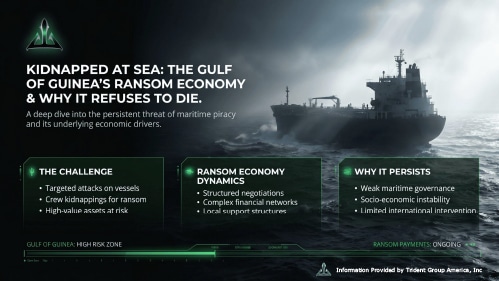

In March 2025, ten crew members were taken from the Panama-flagged tanker BITU RIVER. The abduction happened about 46 nautical miles off Ghana’s coast. This location was far from areas where local authorities have the most control and can respond quickly. A week later, seven crew members from three Ghana-flagged fishing boats were kidnapped in a separate incident. In both cases, the attackers followed a pattern the U.S. Maritime Administration has tracked since at least 2023. Senior crew members, such as masters, chief engineers, and first mates, were removed from the ship and taken ashore into the Niger Delta’s creeks and waterways. There, they were held for weeks during ransom talks (MARAD, 2025). No cargo was stolen, and no ships were kept. The crime was about people, traded for money. This is what sets the Gulf of Guinea apart in global maritime crime. It is not the most incidents or the biggest seizures, but the world’s most advanced and persistent kidnap-for-ransom system at sea. In the first half of 2025, the Gulf of Guinea was responsible for 87 percent of all crew kidnappings worldwide. Yet, it made up only a small share of total incidents (ICC-IMB, 2025). This essay examines why this economy persists, why efforts to stop it have only partially succeeded, and what the ransom model means for managing crew risks in 2026 and beyond.
To understand the Gulf of Guinea’s ransom economy, it’s important to understand what led to its development. For the first 15 years of this century, most maritime crime in West Africa focused on stealing cargo. Criminal groups targeted oil industry ships to take petroleum products and sell them on the black market. They took advantage of Nigeria’s subsidized fuel prices and the region’s weak regulatory framework (Atlantic Council, 2025). While oil theft was profitable, it was also complicated. Hijacking a ship, moving the cargo, and selling it required careful planning, several vessels, and a lot of time. All this increased the risk of getting caught.
The global oil price crash in 2014 changed everything. When crude oil prices fell from over $100 to under $50 per barrel, stealing cargo became much less profitable. The risks and costs were no longer worth it. Pirate groups in the Niger Delta, many with roots in past militant movements against oil companies, switched to kidnapping for ransom (Atlantic Council, 2025). This new approach was simpler and quicker. It brought in money more directly: board a ship, take the most valuable crew members—usually the master and chief engineer, whose absence prevents the ship from operating —and any Western or foreign nationals who could bring higher ransoms—move them ashore, and start negotiations (MARAD, 2025). As MARAD explains, kidnapped crew members are “normally taken ashore in the Niger Delta region where KFR groups demand ransom payments in exchange for the safe return of the crew members” (MARAD, 2025, para. 3).
War on the Rocks documents how, after the 2009 Nigerian amnesty, Gulf of Guinea maritime crime evolved: crime shifted from attacking oil facilities to hijacking tankers for cargo theft, and then to the kidnap-for-ransom model, highlighted by the 2016 hijacking of the MT Maximus off Côte d’Ivoire (War on the Rocks, 2024). This shift benefited criminals—ransom deals are private, resolved quickly, and leave little evidence. In the past decade, Nigerian pirates have kidnapped nearly 1,000 seafarers and locals for ransom. This high number results not from a lack of suspects, but from failures of legal and government systems to apprehend and prosecute them (War on the Rocks, 2024). The vast, ecologically complex Niger Delta underpins this enterprise. It’s 20,000 square kilometers of creeks, mangroves, swamps, and waterways that are largely ungovernable: the terrain is complex, local economies are informal, and authorities are often under-resourced or compromised, preventing sustained interdiction inland (Center for Maritime Strategy, 2025). Modern Diplomacy (2025) notes that piracy prosecution rates remain critically low—regional legal systems struggle to prosecute pirates where piracy is a major concern (Modern Diplomacy, 2025, para. 6).
Pirate groups in the Gulf of Guinea don’t just operate near the coast. MARAD reports attacks up to 300 nautical miles from shore. This shows that pirates use larger ships, called motherships, to help smaller attack boats reach targets far out at sea (MARAD, 2025). This approach is much more organized than the opportunistic attacks seen in places like the Singapore Strait. The March 2025 attack on the BITU RIVER, 46 nautical miles from Ghana’s coast and outside Nigeria’s waters, shows how far the threat has spread. While the Niger Delta remains the main base, attacks have occurred off the coasts of Benin, Cameroon, Côte d’Ivoire, Equatorial Guinea, Gabon, Ghana, São Tomé and Príncipe, and Togo (MARAD, 2025). Maritime Fairtrade’s November 2025 report notes that criminals have moved their operations into waters off different countries to avoid Nigerian patrols. They shift activity to areas with less monitoring (Maritime Fairtrade, 2025).
A common mistake in analyzing Gulf of Guinea piracy is treating it solely as a security issue. Some believe it can be solved with more naval patrols, better surveillance, or regional cooperation. Data from the last ten years shows this view is incomplete. The Atlantic Council’s November 2025 report explains that the real causes of maritime crime—such as weak law enforcement, high youth unemployment, and few economic opportunities in coastal areas—are problems that naval operations can’t fix. Current governance efforts have not solved these problems (Atlantic Council, 2025, para. 2).
The Center for Maritime Strategy’s 2025 report says 242 million people in the Gulf of Guinea live on only $1.90 a day. This is despite the region being a major oil and gas exporter (Center for Maritime Strategy, 2025). Resource wealth leads to poverty instead of development and is central to the piracy problem. Springer Maritime Economics & Logistics says: “while poverty is a factor, the real problem is the mix of unstable politics, bad government, environmental damage, and strong criminal networks that make the Gulf of Guinea especially at risk” (Maritime Economics & Logistics, 2026, para. 4). Many Niger Delta communities—where pirates are from and where hostages are held—have faced pollution, environmental harm, and hardship for years. War on the Rocks calls this the “embeddedness of crime,” in which many see illegal maritime activity not as crime but as a legitimate way to address local problems (War on the Rocks, 2024).
Modern Diplomacy’s analysis adds another challenge for law enforcement: intelligence shows that money from piracy helps fund extremist groups like Boko Haram and the Islamic State West Africa Province (ISWAP). This link between maritime crime and terrorism means that stopping the kidnap-for-ransom economy has security consequences that go far beyond just protecting ships (Modern Diplomacy, 2025). Arms smuggling, oil theft, and human trafficking all happen in the same areas and often involve the same networks. Modern Diplomacy calls these “land-sea networks between pirates and insurgents” and says that all of them must be tackled at once to make real progress (Modern Diplomacy, 2025, para. 5).
The regional and international response to Gulf of Guinea piracy has generated a substantial institutional architecture. The Yaoundé Code of Conduct, established in 2013, created the first coordinated anti-piracy policy framework in the region, including the Yaoundé Architecture Regional Information System for intelligence sharing and the Multinational Maritime Coordination Centers intended to improve response coordination across the 25 participating states (Center for Maritime Strategy, 2025). Nigeria’s $195 million Deep Blue Project delivered command-and-control systems, intelligence infrastructure, and over 100 naval vessels, air platforms, and drones (War on the Rocks, 2024). France’s Operation Corymbe provides persistent satellite tracking support. The U.S. Navy led the 14th Obangame Express maritime security exercise in May 2025 — with 30 countries attending, including 22 African nations — making it the largest multinational maritime security exercise ever held in the region (Center for Maritime Strategy, 2025). Nigeria passed the Suppression of Piracy and Other Maritime Offenses Act in 2019, creating an explicit legal framework for prosecuting maritime crime.
Modern Diplomacy’s review of these efforts is clear: the Yaoundé Code of Conduct “set the ground roots for regional maritime cooperation, but even more than a decade later, implementation remains so weak and patchy at best. The Multinational Maritime Coordination Centers have tried to improve coordination, but intelligence sharing and response time are still very slow against real-world threats” (Modern Diplomacy, 2025, para. 4). The Center for Maritime Strategy points out a key problem with Nigeria’s POMO Act: its anti-piracy rules are separate from other criminal and maritime laws, which causes coordination problems. More importantly, the Act does not address the link between piracy at sea and organized crime on land, so the financial networks in the Niger Delta that support kidnappings are left untouched (Center for Maritime Strategy, 2025). Only 12 percent of piracy cases are prosecuted, and with “inadequate naval resources and jurisdictional overlaps,” most criminals face little risk of being punished (iTelemedia, 2025).
The IMB’s analysis is blunt: the drop in Gulf of Guinea incidents since the 2019-2020 peak is due to successful deterrence in certain areas with specific patrols. But when those patrols change, pirates still have the ability and motivation to carry out kidnappings (ICC-IMB, 2026). The IMB’s 2025 annual report says the Gulf of Guinea saw 23 crew kidnappings in four incidents that year, and pirates “continue to demonstrate the capability to target vessels out at sea” even though the total number of incidents has gone down (ICC-IMB, 2026, para. 5).
The Gulf of Guinea’s ransom economy creates unique challenges for ship operators and crew risk managers, different from other maritime security threats. MARAD’s advisory is clear: KFR groups “generally kidnap senior crew members, such as the master and chief engineer, and any Western or foreign crew members” (MARAD, 2025, para. 3). This isn’t random violence—it’s a targeted process that picks out people whose absence will disrupt the ship the most and whose nationality will bring higher ransom payments. This means that treating all crew members as equally at risk is a mistake. Masters, senior officers, and Western or European crew members face much higher risks than other seafarers on the same ship.
Because of the way these threats work, managing routes and transits in the Gulf of Guinea requires more than just making ships tougher or training crews. Kidnap groups here have shown they can attack ships up to 300 nautical miles from shore, using motherships to reach far beyond normal patrol areas. The BITU RIVER attack in March 2025, 46 nautical miles from shore, was well within their reach (MARAD, 2025). Standard security measures like citadels and hardening the vessel, which work well against opportunistic attacks in places like the Singapore Strait, don’t offer much protection against organized, armed groups who have already chosen their targets and are willing to use violence. MARAD reports that these groups “have fired on vessels during boardings and attempted boardings”—the violence is part of their plan, not an accident (MARAD, 2025, para. 3).
Naval exercises, no matter how large or international, and even the best legal frameworks, won’t solve the Gulf of Guinea’s kidnap-for-ransom problem. The same issues that have caused political instability, inequality, and corruption in the Niger Delta for sixty years keep this economy going. Maritime security operations can help a little, but they can’t fix the root causes. IMB’s 2025 data shows that 87 percent of global crew kidnappings happen in this region, even though it accounts for only a small share of total incidents. This highlights the difference between how often incidents happen and how serious their impact is. That’s why the Gulf of Guinea needs special attention from ship operators and crew risk managers, even if it doesn’t have the most incidents overall. The ransom economy isn’t fading away. It’s quiet in some places, active in others, and always has reasons to continue. For seafarers in West African waters, this is the key point.
Atlantic Council. (2025, November 10). Atlantic piracy, current threats, and maritime governance in the Gulf of Guinea.https://www.atlanticcouncil.org/in-depth-research-reports/issue-brief/atlantic-piracy-current-threats-and-maritime-governance-in-the-gulf-of-guinea/
Center for Maritime Strategy. (2025, August 7). Piracy in the Gulf of Guinea: Progress and future challenges.https://centerformaritimestrategy.org/publications/piracy-in-the-gulf-of-guinea-progress-and-future-challenges/
ICC International Maritime Bureau. (2025, July). Piracy and armed robbery against ships: Report for the period 1 January – 30 June 2025.https://iccwbo.org/news-publications/news/spike-in-armed-robbery-incidents-raises-concerns-for-vital-singapore-strait-trade-route/
ICC International Maritime Bureau. (2026, January 15). Global maritime piracy and armed robbery increased in 2025 — Annual report. https://iccwbo.org/news-publications/report/global-maritime-piracy-and-armed-robbery-increased-in-2025/
iTelemedia. (2025, May 27). 2025 outlook: Piracy surge and what it means for Nigerians.https://itelemedia.com/2025-outlook-piracy-surge-and-what-it-means-for-nigerians/
Maritime Economics & Logistics. (2026, January 13). The economic impact of piracy: A critical assessment of maritime security and trade disruptions in the Gulf of Guinea. https://link.springer.com/article/10.1057/s41278-025-00344-1
Maritime Fairtrade. (2025, November 24). Challenges of maritime security and governance in the Gulf of Guinea: Addressing Atlantic piracy and current threats.https://maritimefairtrade.org/challenges-of-maritime-security-and-governance-in-the-gulf-of-guinea-addressing-atlantic-piracy-and-current-threats/
Modern Diplomacy. (2025, October 13). Piracy in the Gulf of Guinea: Maritime crime and insecurity.https://moderndiplomacy.eu/2025/10/13/piracy-in-the-gulf-of-guinea-maritime-crime-and-insecurity/
U.S. Maritime Administration. (2025, June 18). 2025-008 Gulf of Guinea — Piracy/armed robbery/kidnapping for ransom. https://www.maritime.dot.gov/msci/2025-008-gulf-guinea-piracyarmed-robberykidnapping-ransom
War on the Rocks. (2024, May 17). Gulf of Guinea maritime security: Lessons, latency, and law enforcement.https://warontherocks.com/2024/05/gulf-of-guinea-maritime-security-lessons-latency-and-law-enforcement/