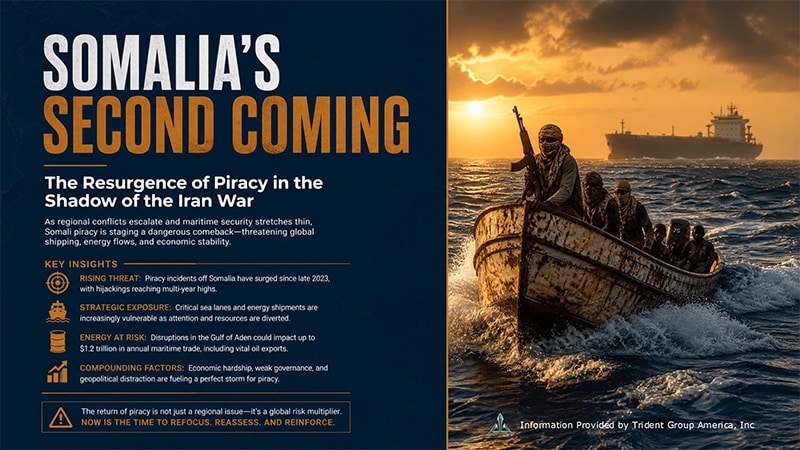

On May 2, 2026, Somali pirates seized the Togo-flagged oil tanker Eureka in the Gulf of Aden as it transported Emirati diesel, boarded it with armed teams, and sailed it to the coast of Somalia’s Puntland region. The ransom demand was $10 million. The hijacking was the fourth seizure in a two-week window spanning late April and early May, and the Eureka was the third vessel that Somali pirates were simultaneously holding when the United Kingdom Maritime Trade Operations authority issued its May 12 advisory confirming the resurgence: two oil tankers and a general cargo carrier, all seized within days of each other, all held in Puntland waters, all the subject of active ransom negotiations (UKMTO, 2026; FDD, 2026). The maritime security community was not surprised. The conditions enabling this resurgence had been documented for months, but a sober recognition that the deterrence architecture that had suppressed Somali piracy from its 2011 peak to near-dormancy by 2020 had failed, quietly and structurally, because the geopolitical crisis in the Middle East had dismantled its operational foundation. Naval assets that had patrolled Somali waters for the better part of two decades had been redeployed to the Persian Gulf. The ships avoiding those waters were rerouting around Africa’s southern tip, sailing directly through Somalia’s traditional strike zones with premium cargoes at elevated oil prices. And the pirate networks waiting for them had spent the preceding months receiving weapons and GPS tracking devices from Houthi forces in Yemen, building a capability to locate, track, and intercept commercial vessels at ranges far beyond anything that characterized the 2009-2012 golden age of Somali piracy (Africa Defense Forum, 2026; FDD, 2026). The second Somali piracy crisis did not emerge from the collapse of Somali governance or the enduring poverty of coastal communities alone. It was handed to the pirates by the Iran war, engineered with Iranian proxy infrastructure, and enabled by a strategic reallocation of Western naval power that left the Horn of Africa as the most consequential security vacuum in global maritime commerce.
The deterrence model that suppressed Somali piracy over the decade following its 2011 peak rested on three interdependent pillars: persistent naval patrol presence in the Gulf of Aden and the Somali Basin, the adoption of Best Management Practices by commercial operators including armed security teams and vessel hardening, and the maintenance of Combined Task Force 151 and EU NAVFOR Operation Atalanta as continuous enforcement presences capable of responding to incidents within hours. The IMB’s 2025 annual report stated the conclusion explicitly: “the lack of a broader resurgence in Somali piracy continues to reflect the strong deterrent effect of sustained naval presence”, a formulation that identified naval presence not as a contributing factor in the deterrence architecture but as its load-bearing element (UKMTO, 2026). When that element was removed, the architecture collapsed.
The removal began on February 28, 2026, when Operation Epic Fury commenced, and the Strait of Hormuz closed. The diversion of naval assets to the Persian Gulf in order to escort commercial shipping through the Hormuz corridor, to support coalition operations against Iran, and to provide the anti-missile defense infrastructure that the Iranian ballistic missile threat required, created what University of Aberdeen international relations lecturer Manu Lekunze described with precision as a “security vacuum.” As he told Marine Insight: “Redeployment from the region to concentrate forces in the Persian Gulf has created opportunities, activating networks that can execute specific pirate missions” (Marine Insight, 2026, para. 6). The EU’s Operation Atalanta publicly maintained that the Middle East conflict had not disrupted its anti-piracy operations and the operation’s rescue of an Iranian-flagged dhow that had been hijacked off Somalia demonstrated residual capability. But the gap between the patrol density that had kept Somali pirate networks dormant and the patrol density available after the redeployment was real, measured in response times and area coverage, and the pirate networks understood it with the operational clarity of organizations that have been watching naval patrol patterns for decades.
The second structural condition was the rerouting of commercial traffic directly into the historically most dangerous piracy zone on the planet. The Hormuz closure that followed Operation Epic Fury forced carriers to circumnavigate Africa rather than transiting the Suez Canal-Red Sea corridor, adding 10 to 14 days to voyage times and approximately $1 million in additional fuel, insurance, and operational expenses per vessel (Marine Insight, 2026). This rerouting delivered something Somali pirate networks had not seen in significant volume since the peak years: dense, predictable commercial traffic transiting the Somali Basin and Gulf of Aden on routes within their operational range. At peak Somali piracy in 2011, the crisis cost shippers and governments an estimated $7 billion, which is the aggregate of ransom payments, security costs, insurance premiums, and counter-piracy operations (FDD, 2026). The conditions approaching those numbers are reassembling. Brent crude above $110 per barrel means the oil tankers now transiting Somali waters carry cargo worth multiples of what similar vessels carried in 2011. Ransom demands of $10 million per vessel, if achieved, exceed the average ransom paid during the original crisis by a factor of three or four. The financial logic of the resurgence is not complicated: premium cargoes, reduced naval coverage, and Houthi-provided capability to find and track the vessels carrying them.
The Somali piracy resurgence of 2026 is structurally distinct from its predecessor in one critically important dimension: the pirate networks are not operating alone. The relationship between Iranian-backed Houthi forces in Yemen and Somali pirate groups, documented by Puntland Maritime Police Force Deputy Director of Intelligence Mohamed Musa Abulle in January 2026, represents something genuinely new in the history of maritime piracy: a deliberate, state-directed transfer of military-grade technology and tactical training to criminal networks, designed to extend the geographic reach of Iran’s maritime disruption strategy without committing Iranian or Houthi assets directly (Africa Defense Forum, 2026; Washington Times, 2025). Abulle’s statement was unambiguous: “Some of the Somali pirate groups have received GPS devices and weapons from the Houthis or Houthi-aligned actors in Yemen. Some of them we believe have even conducted training in Yemen” (Washington Times, 2025, para. 3). The specific capability transferred — GPS satellite tracking devices that “allow pirates to accurately track the routes of commercial vessels” — addresses precisely the limitation that had historically constrained Somali pirate operations at long range: the inability to reliably locate specific targets in open ocean before committing a fast-attack skiff or mothership to an interception run (Africa Defense Forum, 2026).
The Foundation for Defense of Democracies’ May 14, 2026 analysis of the Houthi-pirate nexus documented the broader criminal architecture into which this technology transfer fits. The UN Panel of Experts on Yemen’s October 2025 report found growing ties between the Houthis and al-Shabaab, Somalia’s al-Qaeda affiliate, including documented meetings in July and September 2024 in which al-Shabaab requested advanced weapons and training from Houthi representatives. The agreed basis for this relationship was explicitly transactional: “al-Shabaab was to increase piracy activities within the Gulf of Aden” in exchange for weapons and training claerly establishing that the Houthis are using the Somali piracy network as a surrogate maritime disruption capability that generates financial returns for the pirates while serving Iranian strategic interests in destabilizing the Gulf of Aden corridor (FDD, 2026; Africa Defense Forum, 2026). RTCOM Defense CEO Ido Shalev characterized the operational division of labor with precision: “There is an opportunistic alignment, with the Houthis providing geopolitical cover and advanced GPS and surveillance, and Somali groups providing the boots on the ground or skiffs on the water” (Fox News, 2026, para. 5). The proximity of the Eureka hijacking to the coast of Yemen as the vessel was seized in the Gulf of Aden, transit distance from Houthi-controlled territory, before being sailed to Puntland, has reinforced regional officials’ assessment that the operation involved Houthi coordination rather than purely independent Somali initiative (FDD, 2026).
The Puntland Maritime Police Force’s December 2025 interception of a boat off the coast of Eyl carrying explosives and chemicals used for making explosive devices established that the weapons transfer was not merely theoretical intelligence. The hardware was physically moving (Africa Defense Forum, 2026). The UN Analytical Support and Sanctions Monitoring Team’s characterization of the Houthi-Somali relationship as “transactional or opportunistic rather than ideological” accurately describes its current state while understating its strategic implications (Africa Defense Forum, 2026). Transactional relationships between state-backed militant organizations and criminal networks are historically durable when they are mutually profitable, and the current arrangement is profitable for every participant. The Houthis extend their maritime disruption capability without committing their own assets. The pirates receive technology that multiplies their operational range and targeting precision. Iran achieves additional pressure on international commercial shipping at no direct cost to its own forces. The alignment does not require ideological coherence to be operationally effective. It requires only that the economic and strategic interests of each party remain aligned, which, as long as the Iran war continues and oil prices remain elevated, they do.
What the Resurgence Looks Like on the Water
The operational profile of the 2026 resurgence differs from the 2009-2012 period in ways that matter for how commercial operators assess and respond to the threat. The original Somali piracy crisis was characterized by high volume, meaning hundreds of attacks per year, many against vessels that happened to be in the wrong place at the wrong time, targeting bulk carriers and tankers without specific advance targeting intelligence. The 2026 model is lower-volume but higher-precision. The Houthi-provided GPS tracking capability allows pirate groups to conduct advanced route surveillance, identify specific vessels carrying high-value cargoes such as oil tankers loaded with premium crude or refined products in the $100-plus per barrel environment, and plan interceptions rather than simply patrol high-traffic areas waiting for targets of opportunity (Africa Defense Forum, 2026; FDD, 2026). The selection of the Eureka, a tanker carrying Emirati diesel, as the $10 million ransom target is consistent with this selective, high-value targeting model: the cargo’s origins in the UAE give the ransom demand political as well as financial leverage, and the vessel’s commodity classification maximizes the per-vessel return relative to the operational investment.
The UKMTO’s May 12 advisory, which confirmed the three active hijackings and urged transiting vessels to “maintain heightened vigilance”, represents the operational intelligence picture available to commercial operators in real time (UKMTO, 2026). The BMP Maritime Security guidance remains the foundational framework for commercial vessel hardening and watchkeeping in the Somali Basin and Gulf of Aden, and its recommendations — armed security teams, citadel protocols, razor wire, fire hoses, evasive maneuvering — remain valid countermeasures against the boarding tactics that Somali pirates employ. What the Houthi GPS transfer does not change is the fundamental vulnerability point: a vessel that can be tracked from a distance, whose position and course are known to a pirate group hours before the interception attempt, faces a different tactical environment than a vessel that is simply unlucky enough to be in a heavily patrolled area when an opportunistic pirate group happens to be nearby. Armed security teams remain the most effective deterrent against boarding once a skiff approaches within engagement range. In their traditional sense, they provide limited protection against the prior phase, consisting of the surveillance and targeting process that the Houthi GPS devices have now extended to ranges where the pirate’s intentions are invisible to the vessel being tracked.
The resurgence’s insurance and routing implications are developing rapidly and have not yet reached their full commercial expression. War risk underwriters who had been adjusting premiums downward in the Somali Basin following years of reduced incident frequency are reassessing the corridor amid active hijackings, Houthi-pirate coordination, and the naval patrol vacuum confirmed by both the UKMTO and independent analysts (FDD, 2026; Marine Insight, 2026). The paradox facing commercial operators is structural: the rerouting around Africa that was adopted to avoid Hormuz war risk exposure is routing vessels through a corridor where the same conflict has recreated the security conditions that generated the first Somali piracy crisis. There is no safe corridor. The Suez-Red Sea route is closed or operationally hazardous due to Houthi threats and the Iran war’s geographic spread. The Cape of Good Hope route is now operationally expensive and tactically exposed to a piracy resurgence whose enabling conditions are directly connected to the same conflict generating the northern route’s risks. The $1 million additional per-vessel cost of Cape routing does not include the K&R insurance, additional war risk premium, and armed security team costs required by the Somali Basin exposure, which did not apply to the same route twelve months ago (Marine Insight, 2026).
FDD’s documentation of the Houthi transit fee model, with the UN reporting possible Houthi earnings of up to $180 million per month in safe-transit fees, provides the financial template that the FDD analysis notes Somali pirates “may see a similar extortion opportunity” in, particularly given that Iran is now charging $2 million per vessel to transit the Strait of Hormuz (FDD, 2026). The potential for a parallel Somali Basin extortion economy, where operators pay a fee to pirate networks in exchange for assurance that their vessel will not be targeted, represents the monetization model that the original Somali piracy crisis never achieved at scale because naval interdiction kept the pirates too operationally pressured to sustain it. The 2026 environment, with reduced naval pressure and Houthi-provided targeting capability, is more permissive to that model than any environment since 2011.
The operational response framework for the 2026 Somali Basin threat combines the established BMP Maritime Security posture with intelligence-led adaptations that the Houthi GPS transfer makes specifically necessary. Armed security teams remain non-negotiable for vessels transiting the Gulf of Aden and Somali Basin at current threat levels. The UKMTO advisory’s “heightened vigilance” recommendation presupposes a security capacity aboard the vessel capable of acting on what that vigilance detects. But the pre-transit intelligence function has become as important as the onboard security posture, because the Houthi GPS tracking capability means that a pirate group’s decision to target a specific vessel may be made hours or days before the vessel enters the engagement zone. Operators who file accurate voyage plans through official channels, as SOLAS requires, are simultaneously providing the tracking data that compromised information channels can deliver to targeting networks. The tension between regulatory compliance and operational security in an environment where targeting intelligence is being collected through state-sponsored surveillance is not resolvable through existing guidance frameworks and represents an area where the BMP Maritime Security documentation will need to be updated to reflect the 2026 threat model.
The broader strategic point that the FDD analysis makes is that the Somali resurgence represents “another attempt to interfere with international trade on behalf of their patrons in Iran” and frames the commercial security challenge within its correct geopolitical context (Fox News, 2026, para. 7). The Somali pirates seizing oil tankers in the Gulf of Aden in May 2026 are not operating independently of the strategic competition playing out in the Persian Gulf. They are one element of a maritime disruption strategy whose architect is Tehran and whose instruments include Houthi missiles, Iranian fast-attack boats, and now Somali pirate skiffs guided by Houthi GPS devices to the same tankers that Iran is simultaneously blocking from exiting through Hormuz. Understanding the commercial security implications of the Somali resurgence requires understanding this strategic architecture, because the security response adequate to opportunistic criminal piracy is not adequate to a threat that is being resourced, directed, and coordinated by a regional power with strategic objectives that extend far beyond the ransom demands being made for the Eureka and its companion vessels.
Somalia’s second piracy golden age was not an accident. It was the predictable consequence of a specific geopolitical event, the Iran war, dismantling the three structural conditions that had suppressed the first one: sustained naval patrol presence, manageable commercial traffic volumes in the Somali Basin, and the absence of state-sponsored tactical support for pirate networks. The Iran war redeployed the naval assets, rerouted the commercial traffic, and, through the Houthi weapons and GPS transfer, provided the pirate networks with the targeting technology to make full use of both developments simultaneously. As of mid-May 2026, three vessels are being held for ransom, reaching $10 million per ship, a fourth hijacking has been documented in the same two-week window, and the commercial shipping industry is confronting the realization that the safe corridor it adopted to avoid the Iran war’s northern front has delivered it into the resurgent southern one. The deterrence model that worked from 2012 to 2025 worked because its enabling conditions were stable. Those conditions no longer exist. The security posture adequate to the current Horn of Africa threat environment must be built for what that environment actually is, not for the one that existed before February 28, 2026.
Africa Defense Forum. (2026, January 27). Houthis provide Somali pirates with advanced tech. https://adf-magazine.com/2026/01/houthis-provide-somali-pirates-with-advanced-tech/
Foundation for Defense of Democracies. (2026, May 14). Iran-backed Houthis assist resurgent Somali pirates. https://www.fdd.org/analysis/2026/05/14/iran-backed-houthis-assist-resurgent-somali-pirates/
Fox News Digital. (2026, May 14). Report: Somali pirates team up with Houthi terrorists to attack key oil trade route. https://www.breitbart.com/africa/2026/05/04/report-somali-pirates-team-up-with-houthi-terrorists-to-attack-key-oil-trade-route/
Marine Insight. (2026, May 21). Piracy off Somalia rises again as Iran-U.S. war forces ships to take dangerous detours around Africa. https://www.marineinsight.com/somali-piracy-rises-again-as-iran-u-s-war-forces-ships-to-take-dangerous-detours-around-africa/
UK Maritime Trade Operations. (2026, May 12). UKMTO advisory: Somali piracy resurgence — three vessels held. https://www.ukmto.org
UK Maritime Trade Operations / Joint Maritime Information Centre. (2026, April 12). Update 031 to JMIC Advisory Note: 01 March – 12 April. https://www.ukmto.org/-/media/ukmto/products/update-031—jmic-advisory-note-12-april_final.pdf
Washington Times. (2025, December 17). Somali pirates stage comeback with Houthi support. https://www.washingtontimes.com/news/2025/dec/17/somali-pirates-stage-comeback-houthi-support